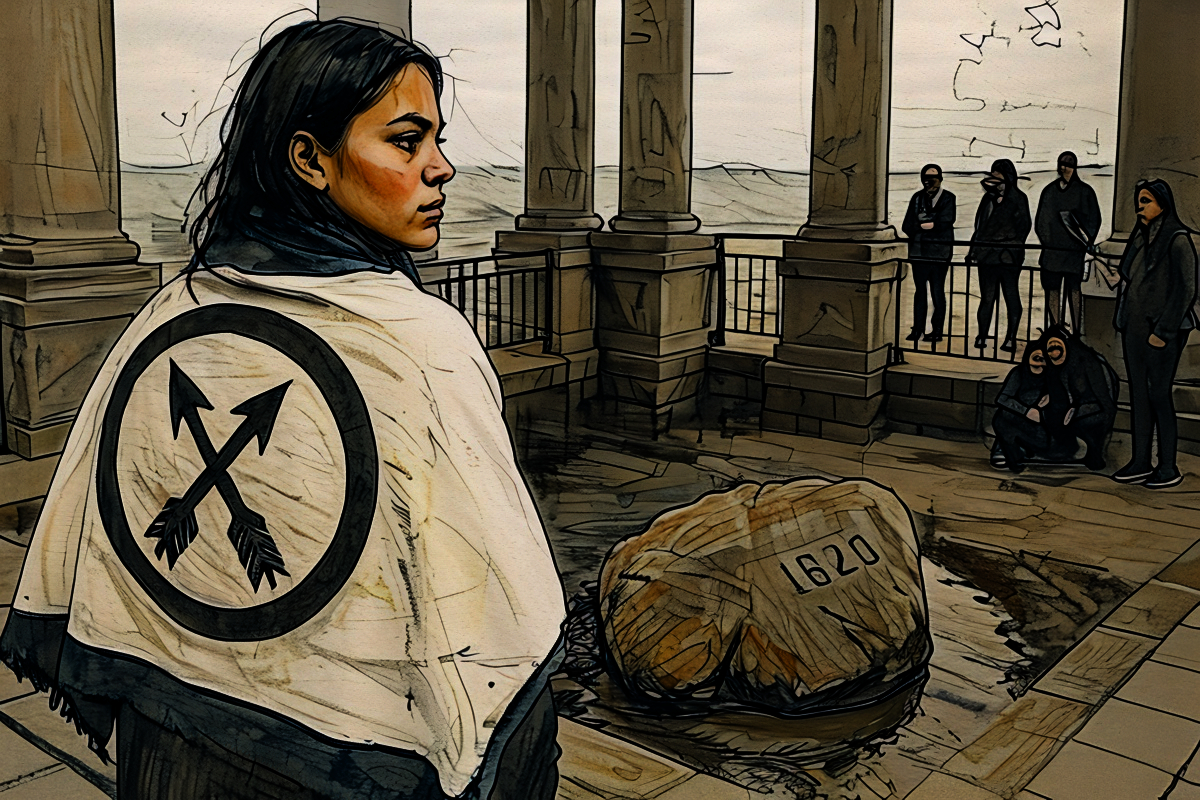
The true story of Thanksgiving was never carved in stone—only carried on the wind.
The briny wind off Plymouth Harbor tugs at coat collars—salt, smoke, and damp. Tourists drift between T-shirts, tricorne hats, and granite plaques, unaware that the stones beneath their feet once held Patuxet. Its outline remains—not visible, but traceable through time. A smear of red paint clings to the base of the monument, dry but not yet faded. From the top of the hill, a drum begins. A voice follows—part chant, part warning: When you feast on our tablecloth, you dine on stolen land. The phrase has echoed through Day of Mourning gatherings since 1970.
They were told they were entering wilderness. But the settlers of 1620 arrived in the aftermath of devastation. For three years before their landing, an epidemic—possibly leptospirosis or viral hepatitis—swept the coastal Indigenous communities. Entire villages collapsed. In some, only one in ten survived.¹ Crops rotted. Many bodies went unburied. To the English, it looked like providence. To the Wampanoag, it was the edge of survival.
They mistook the silence of catastrophe for peace.
This was no untouched land. Before European contact, what is now the continental United States held between 2.5 and 7 million Indigenous people across hundreds of distinct nations.² In the Northeast, confederacies like the Wampanoag, Massachusett, and Nipmuc spoke related Algonquian dialects, traded along rivers and coastlines, and negotiated shifting borders. A 2025 demographic study based on radiocarbon evidence found dense riverine and coastal settlements through the early 1600s.³
At the modern Patuxet Homesite, Wampanoag educators light cooking fires inside traditional wetus, surrounded by schoolchildren in windbreakers and baseball caps.