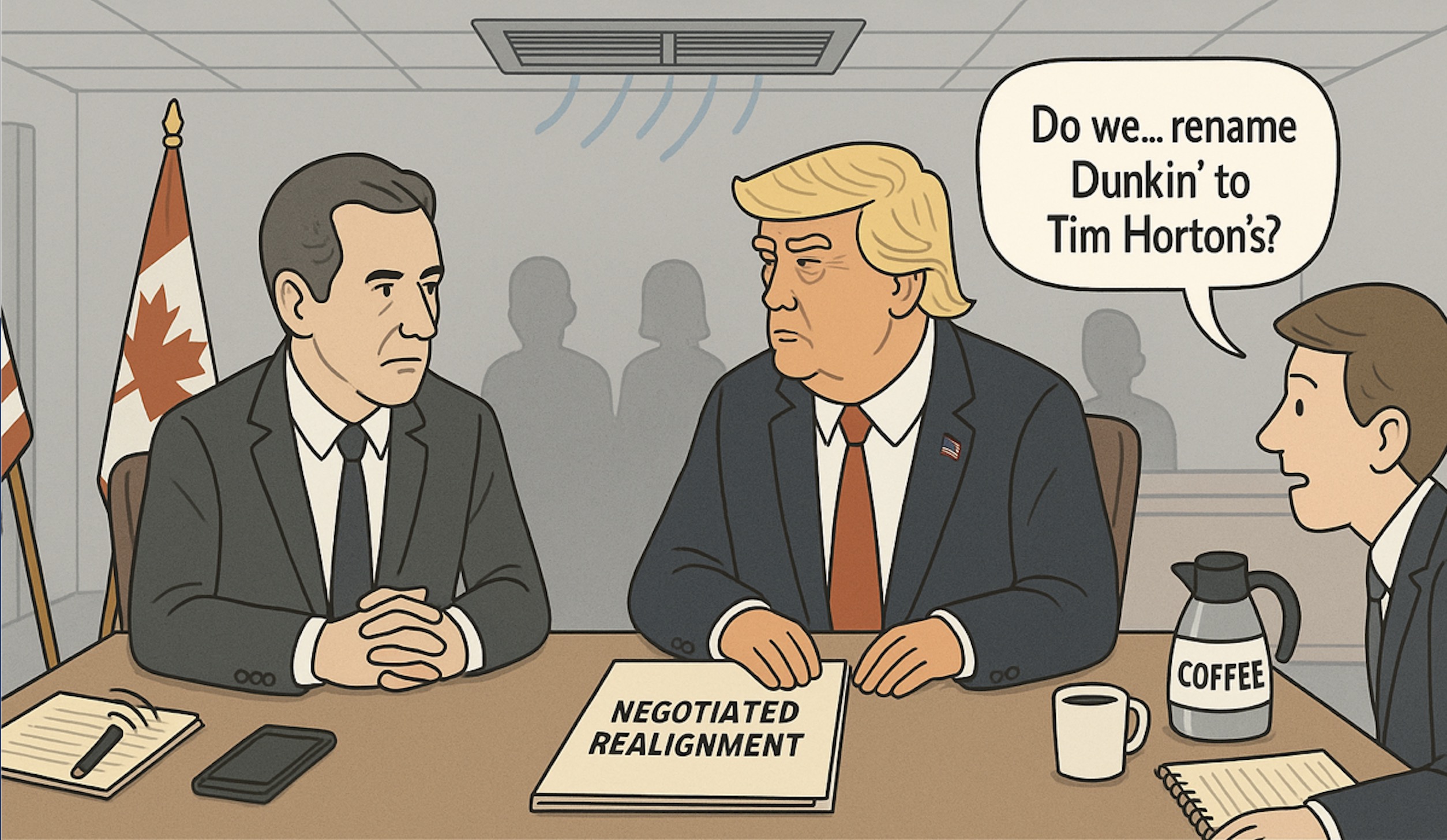
Fiction? Maybe not. At least TGIF.
The room was overcooled and smelled like burnt coffee. Flags stood in their brass cups like polite witnesses. Marcel Lagauche, in his first weeks as Prime Minister of Canada, pushed a thin folder back across the table. The tab read: Alberta Accession — Concept Note.
“Canada declines,” he said, voice even. “There is no conversation about provinces leaving Canada.”
Two hours earlier, his security team had walked him through a secret Pentagon white paper—Trump’s request—sketching a “safe zone” enforced by a newly named Ice Corps: a single internal police command built from the National Guard and ICE, reporting to Trump. It would push U.S. authority one hundred miles into Canada and, “on a temporary basis,” sweep in roughly eighty-two percent of Canadians. He closed the folder and decided to put the law on the table before someone put boots and badges on it.
Trump didn’t bother with small talk. “The real plan is Canada as the fifty-first. But I’m a dealmaker—I can compromise. We take Alberta—maybe Saskatchewan—call it energy independence. Done.”
“Provinces are not parcels,” Lagauche said. “They are citizens.”
Trump pinched the bridge of his nose—his deliberative face—but the sales job was already cued up. He’d sounded out a pipeline operator, floated carve-outs to a friendly fund, teased warrants and naming rights that travel with a new map. A family office had already registered a token ticker—MAPLE.
“We need a deal that works for both sides,” he said. “Reciprocity. You take New England—Connecticut through Maine—as a new province. I move a lot of leftist troublemakers off my map—Harvard included—and you get ports and libraries. Everybody wins.”
Lagauche laid down a second folder. “Here is the only framework Canada will discuss,” he said. “First, both countries publicly renounce any cross-border ‘safe zone.’