Most Americans do not wake up thinking about Article III, the Electoral College, campaign-finance doctrine, or the finer points of the Voting Rights Act. They wake up wondering why the system feels so hard to trust. Why do politicians seem to pick their voters instead of the other way around? Why do billionaires seem to have a louder voice than teachers, nurses, and small-business owners? Why does every Supreme Court vacancy feel like a national emergency?
That is the problem Robert Reich has been trying to answer. And on the diagnosis, he is largely right: American democracy needs repair.
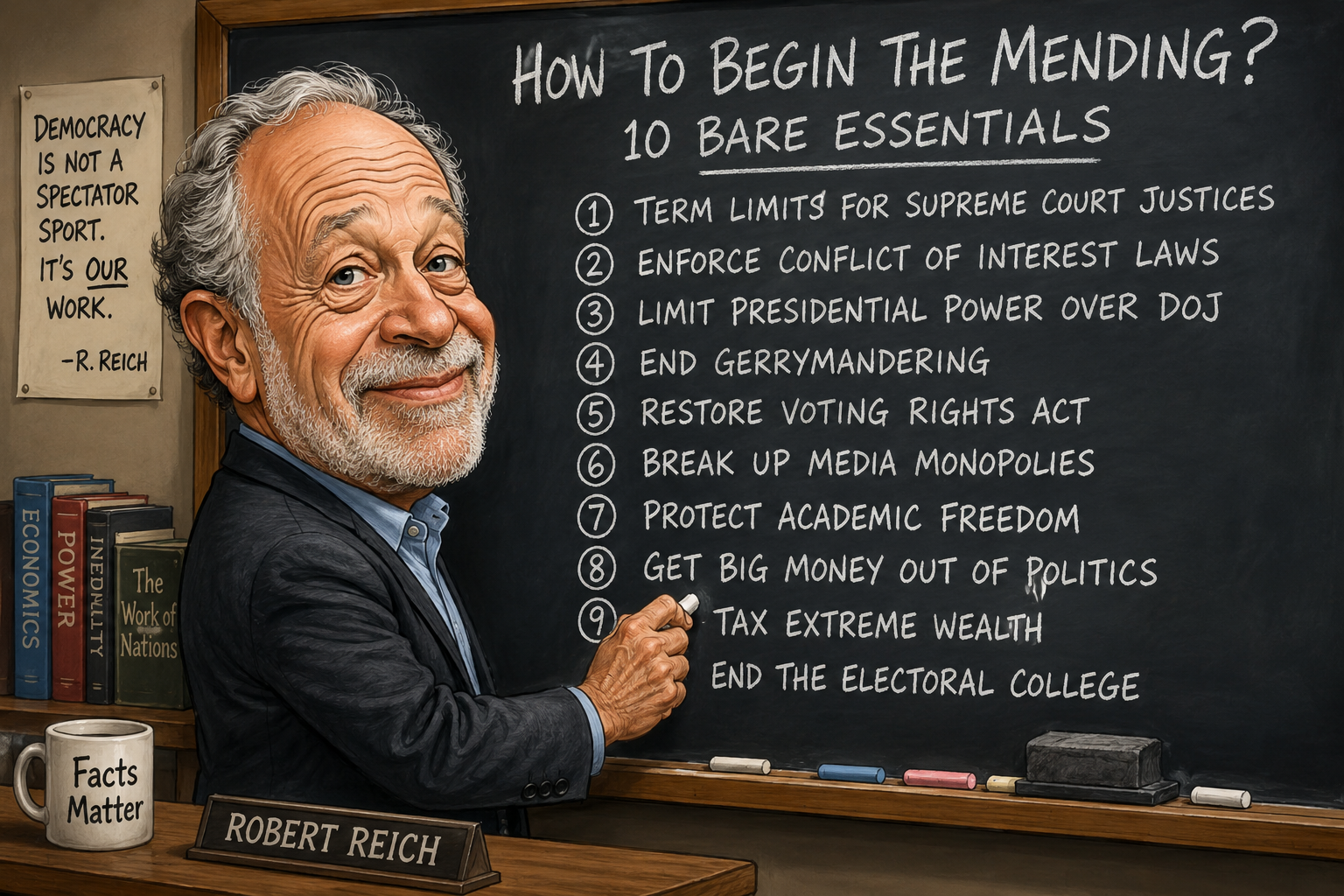
Reich is not just another online commentator. He served as U.S. Secretary of Labor under President Bill Clinton, taught public policy at UC Berkeley, and has spent decades arguing that economic power and political power are now dangerously intertwined.¹ On July 4, as America marked its 250th anniversary, Reich wrote that real patriotism is not flag-waving or slogan-shouting, but the hard civic work of preserving democracy. The next day, in “Sunday Thought: How To Begin the Mending?,” he offered ten “bare essentials” for repairing American government.²
The list is long, but it deserves to be read in full because it shows the scale of what Reich is proposing. He is not offering minor adjustments. He is calling for major structural reform: term limits for Supreme Court justices, tougher conflict-of-interest laws, limits on presidential interference with the Justice Department, independent redistricting commissions, renewed voting-rights protections, media-ownership restrictions, academic freedom protections, campaign-finance reform, taxes on great wealth, and abolition of the Electoral College.