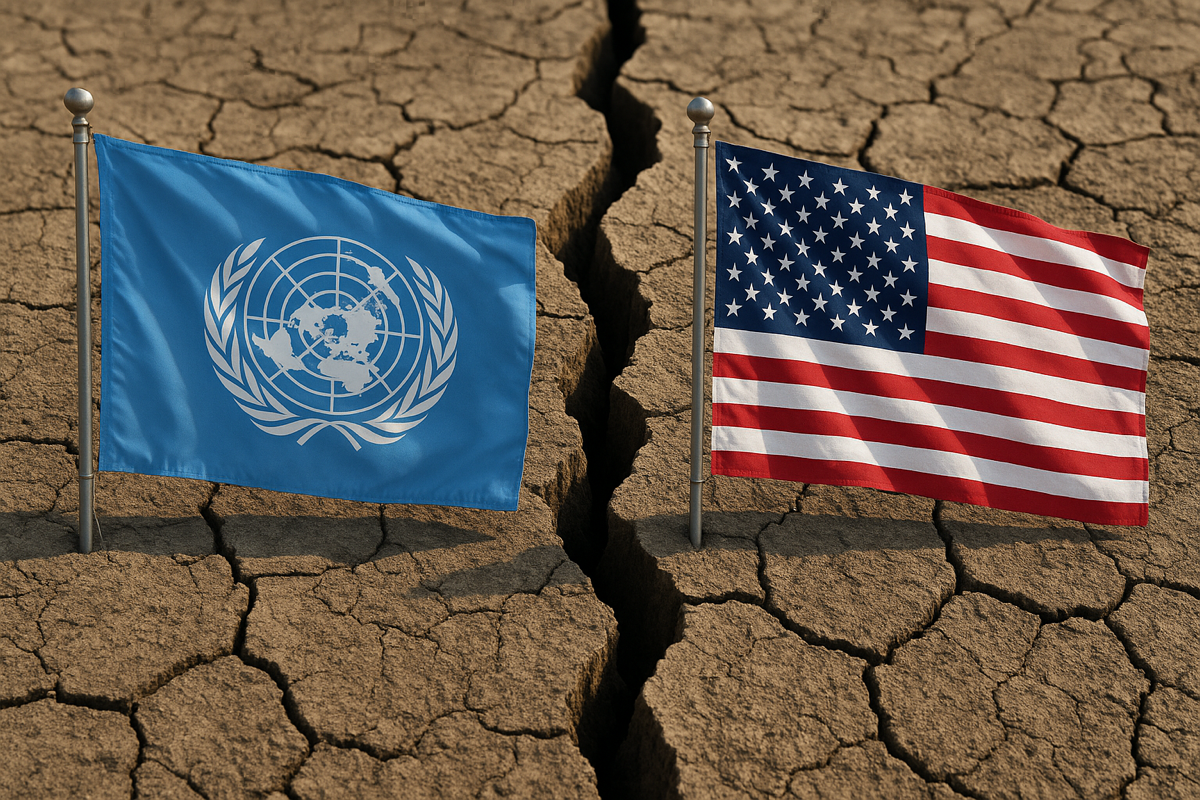
The blue barricades on First Avenue looked like a diagram of caution—angles, choke points, a geometry of waiting. Down the block from the U.N.’s glass curtain, a woman in a navy blazer folded a newsprint into quarters and said, to no one in particular, that the city always feels “held” during high-level week, like breath before a verdict. Inside, the verdict came in rapid succession: Britain, Canada, Australia, and Portugal—four capitals in less than twenty-four hours—each declared recognition of the State of Palestine¹. Applause broke in Ramallah, fury boiled in Jerusalem, and in Washington, the calculus began to shift.
Portugal’s foreign minister, Paulo Rangel, stood in New York and said the words plainly, pairing recognition with a ceasefire demand, a rejection of Hamas’s role in Gaza, and a warning that settlement expansion “erodes” statehood². He stressed it was no solo leap—it was coordinated with London, Ottawa, and Canberra.
“We recognize the State of Palestine.” It was the same sentence, repeated four times in a single day, by governments that had run out of excuses for delay.
On paper, the build-up had started a week earlier when the General Assembly adopted a resolution condemning Hamas’s October 7 atrocities, condemning Israel’s starvation tactics in Gaza, and urging “tangible, timebound, and irreversible steps” toward a two-state solution³. Diplomats called it symbolic but not toothless. The stage was set by absence as much as presence: the Security Council had blocked Palestine’s membership in 2024 with a U.S. veto, leaving the flag still outside the circle of full states⁴.
“Recognition is political; membership is procedural—and vetoable.” That gap explains why the hallways hummed even after the gavel fell.
On the sidewalks, the story had a quieter rhythm.