Finally I asked what was wrong.
The woman answered.
“Nobody reads music here.”
She said it casually, not as criticism—just as a fact about how some studio musicians actually worked. Many of them played by ear, by memory, by feel. They improvised constantly, shaping phrases in ways that depended on subtle timing and expression. Traditional music notation wasn’t always part of their world, and in many ways it wasn’t precise enough to capture what they were actually doing.
A few minutes later I learned her name.
It was Stevie Nicks.
That comment stayed with me. It had nothing to do with notation and everything to do with how musicians actually recognize patterns in sound.
Instead of ending the conversation, it started a short brainstorming session. If some studio musicians didn’t rely on written notation, the software needed another way to show what the computer was hearing.
Within a few minutes, we were sketching an alternative: a piano-roll display. Time ran horizontally across the screen and notes appeared as bars whose length represented their duration, with color showing the intensity of each note.
It was easier to read.
It was easier to edit.
And it turned out to be far more precise.
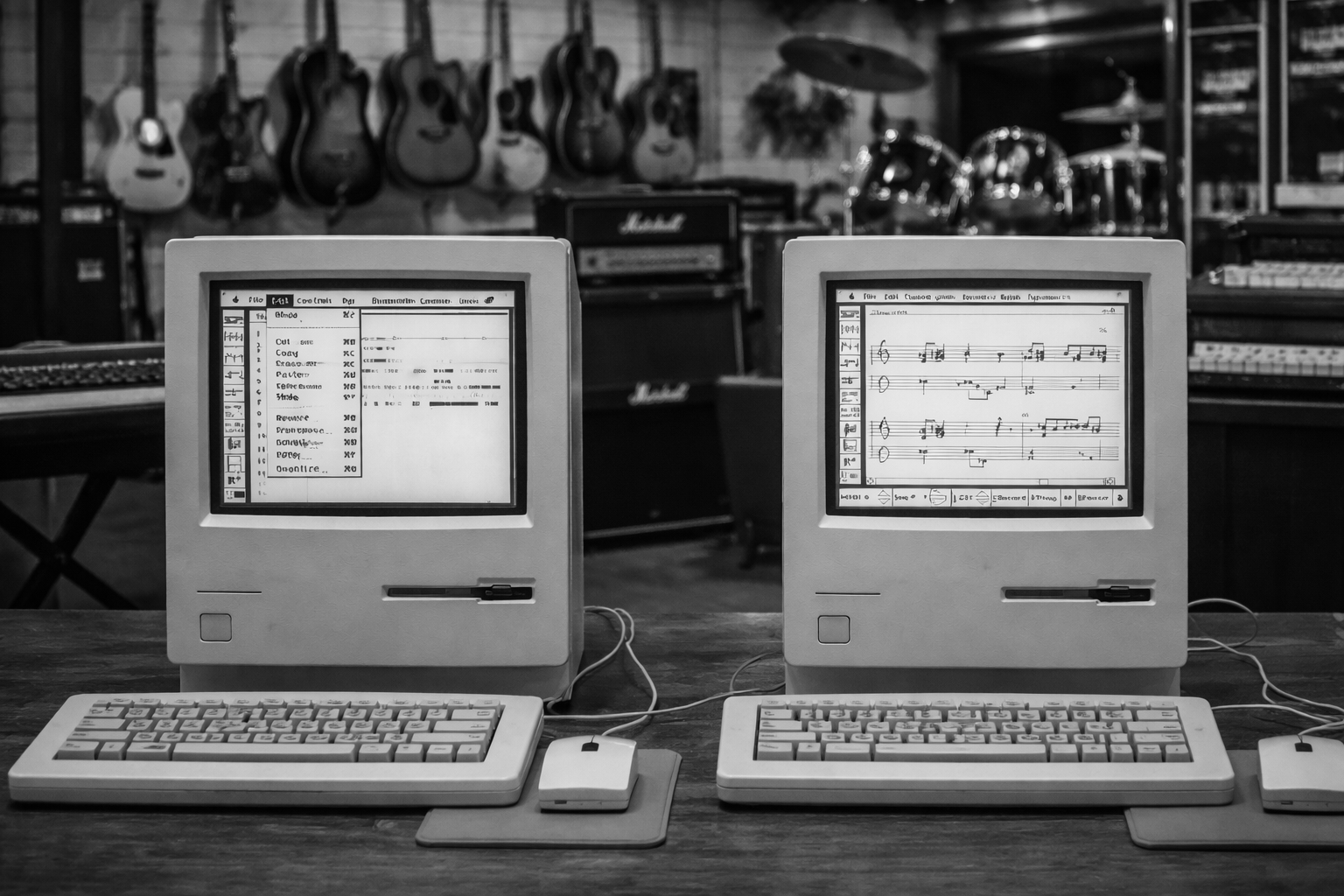
That moment—sitting in a recording studio with a loose parrot in the hallway and Stevie Nicks pointing out a flaw in my software—brought back a problem I had run into earlier.
The first time it appeared had nothing to do with music.
It showed up in machines that were trying to see.
In the summer of 1983 I served on the board of a machine vision company called Datacube. They had asked me to help figure out how to reinvigorate the company’s product line. Datacube built hardware that allowed industrial robots to “see,” which is how I ended up wandering the aisles of a robotics conference in Chicago.
Before that trip I spent weeks trying to understand how those vision systems actually worked. Much of that studying happened the old-fashioned way—sitting in the MIT library or collecting textbooks at the MIT Coop or Quantum Books in Kendall Square.
The terminology in those books sounded intimidating: convolution, edge detection, morphological operations.
But once you peeled away the math, the idea underneath was surprisingly simple.
Inside a computer an image is just a grid of numbers representing brightness. The machine scans those numbers looking for shapes by comparing one pattern of pixels to another. A row of bright pixels next to dark ones might indicate an edge. A certain arrangement of edges might suggest a bolt head or a hole in a metal plate moving down an assembly line.
The computer didn’t know what any of those things were.
It was simply measuring resemblance.