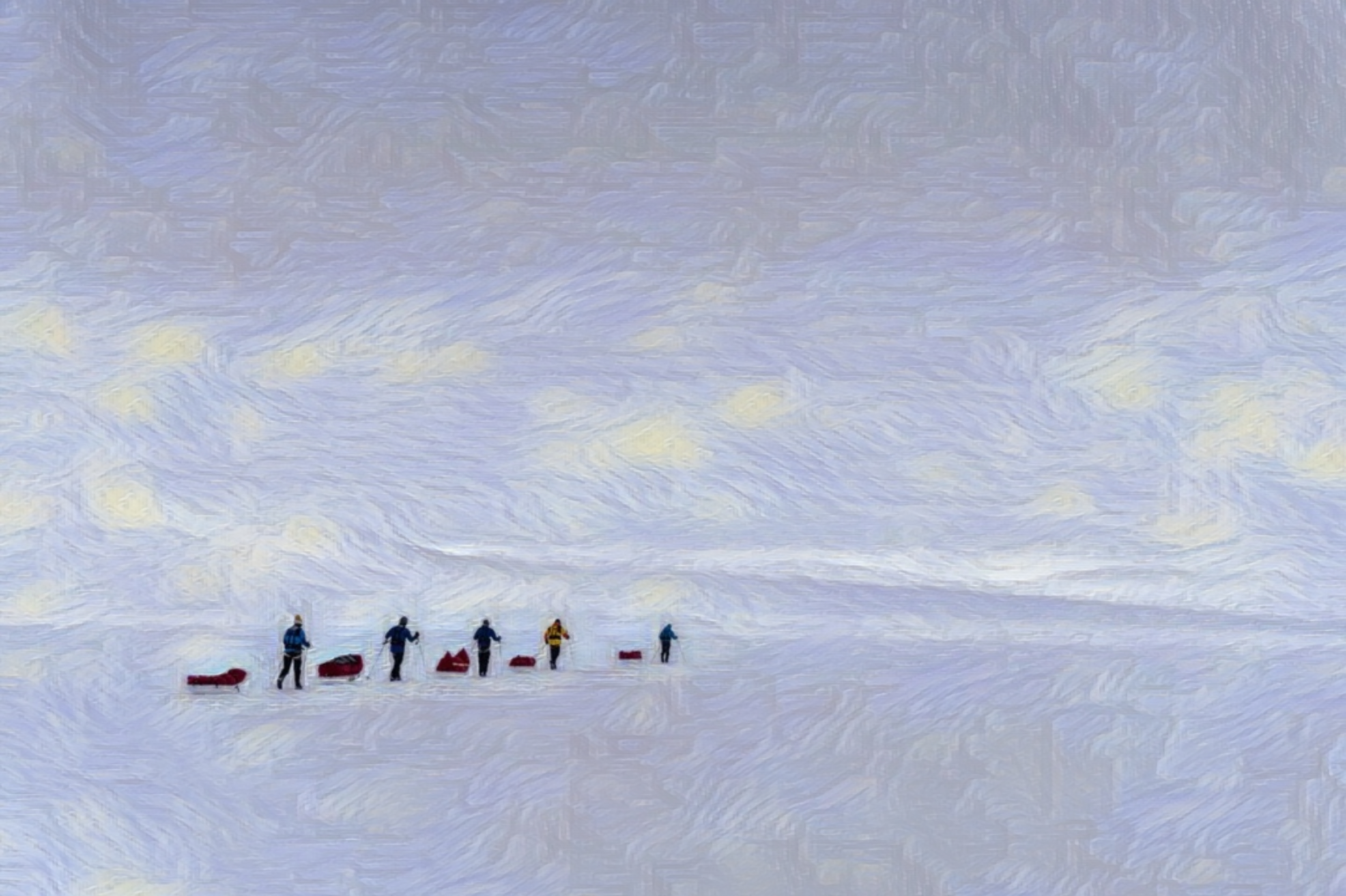
The cold is a presence, not a temperature. Somewhere on Greenland’s inland ice, Susana Hancock drives her skis into ridges sharp as frozen waves, a −40° wind clawing at her goggles. Behind her, four teammates tug supply sledges that groan across the crust. Ahead, the horizon folds white into white. At each stop she kneels, buries a sensor in the snow, and moves on. They record how fast the ice is leaving.¹
Thirty-eight, from Freeport, Maine, she is known at home for dragging three truck tires around a supermarket lot; out here the same rhythm of pull and drag is her life. At the International Cryosphere Climate Initiative, her work is to bend polar data into a language policymakers can no longer ignore. She calls the journey obligation: to live the ice before carrying its story into the rooms where policy is written.²
Her trek began in mid-August on Greenland’s east coast, near the same ice face where Fridtjof Nansen set off in 1888.³ His expedition of six men hauled reindeer-hide sledges over 260 miles of wasteland, reaching Godthaab (now Nuuk) and proving Greenland was not jagged peaks but one continuous shield of ice. His strategy was cruelly simple: burn the boats, cut off retreat. “Death or the west coast of Greenland,” he wrote later.⁴
Hancock isn’t out to prove continuity but collapse. Greenland has been losing 250 gigatons of ice each year.⁵ Enough to drown Maine beneath a meter of water. In 2021, rain fell on the summit of the ice sheet—3,200 meters high—for the first time in recorded history.⁶ In 2025, it happened again, the quiet of snow broken by a sound no one expected: rain tapping the Arctic.⁷
“The ice is no longer fortress—it has doors, and the rain knows how to open them.”