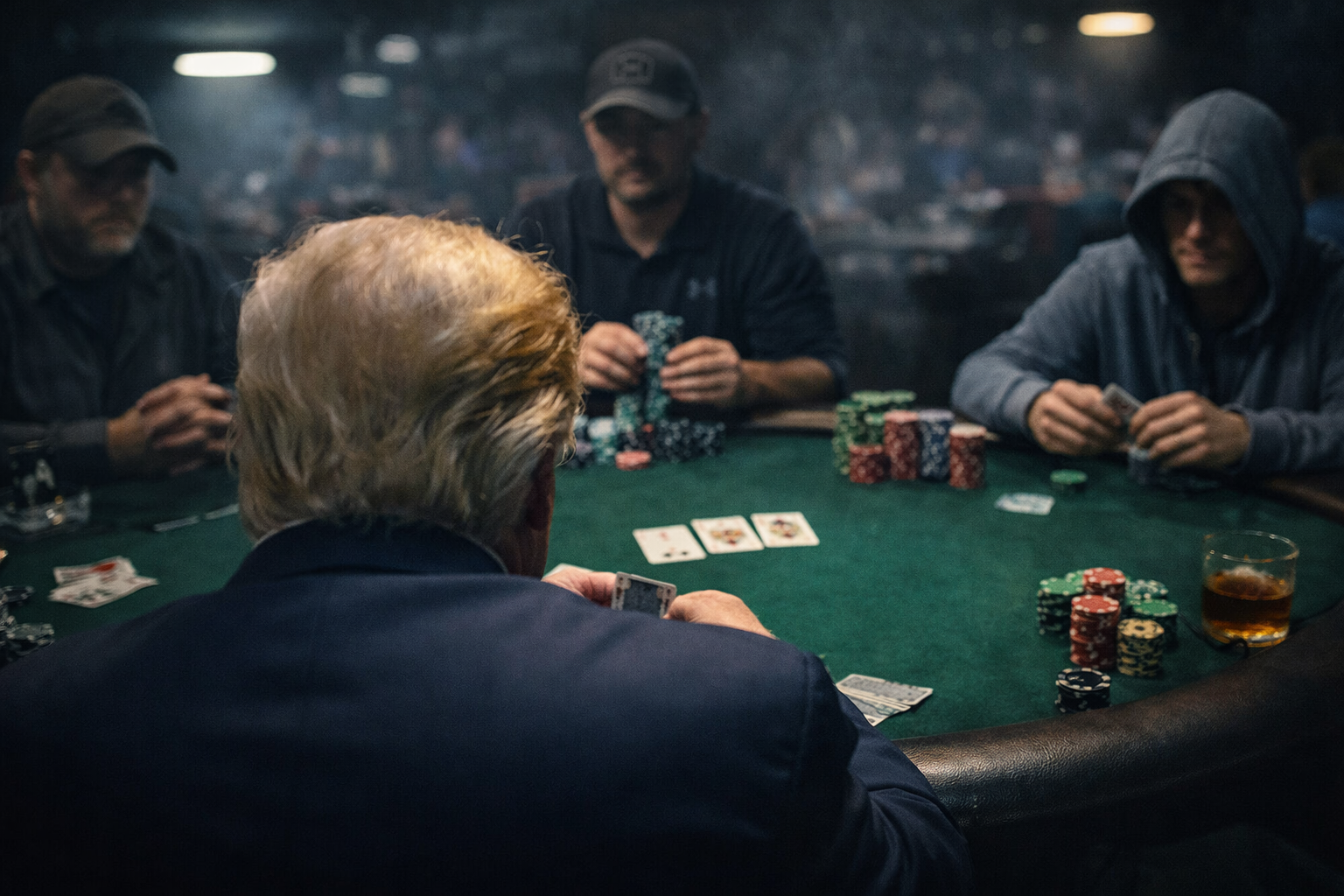
The table absorbed sound the way good tables do—leaving nothing but the parts people didn’t mean to reveal.
A man in a gray hoodie leaned back, riffling chips, listening not for information but for drift—the moment a sentence leans too hard, when detail appears where none is needed, when certainty arrives a beat too quickly. Across from him, the other player filled the space with big hands and bigger moments, just enough specificity to sound real, not enough to be pinned down. The man in the hoodie folded, not because of the cards, but because of the pattern.
That’s the part people miss about poker. It isn’t about catching a lie. It’s about recognizing the shape of one while it’s still being built.
Carry that habit out of the room—into a rally, an interview—and something similar begins to emerge. Not in what’s said, but in how it’s constructed. Back in 2016, when reporters were still trying to map Donald Trump onto something familiar, a professional poker player offered a line that has aged better than most early assessments:
“Trump doesn’t have significant tells when he’s lying because truth and lies… are homogenized.”¹
In poker, the system depends on tension—the difference between a strong hand and a weak one. That tension leaks. Hands shake, timing slips, the body gives something away. But remove the friction—flatten the distinction between what’s accurate and what’s useful—and the classic tells don’t fire. They don’t disappear; they migrate.
Daniel Negreanu calls poker “a people game played with cards.” Phil Hellmuth reduces it to a rule players trust: “Weak means strong, and strong means weak.”² Overcompensation is the signal. When someone leans too hard on certainty, certainty is doing the work the facts can’t.