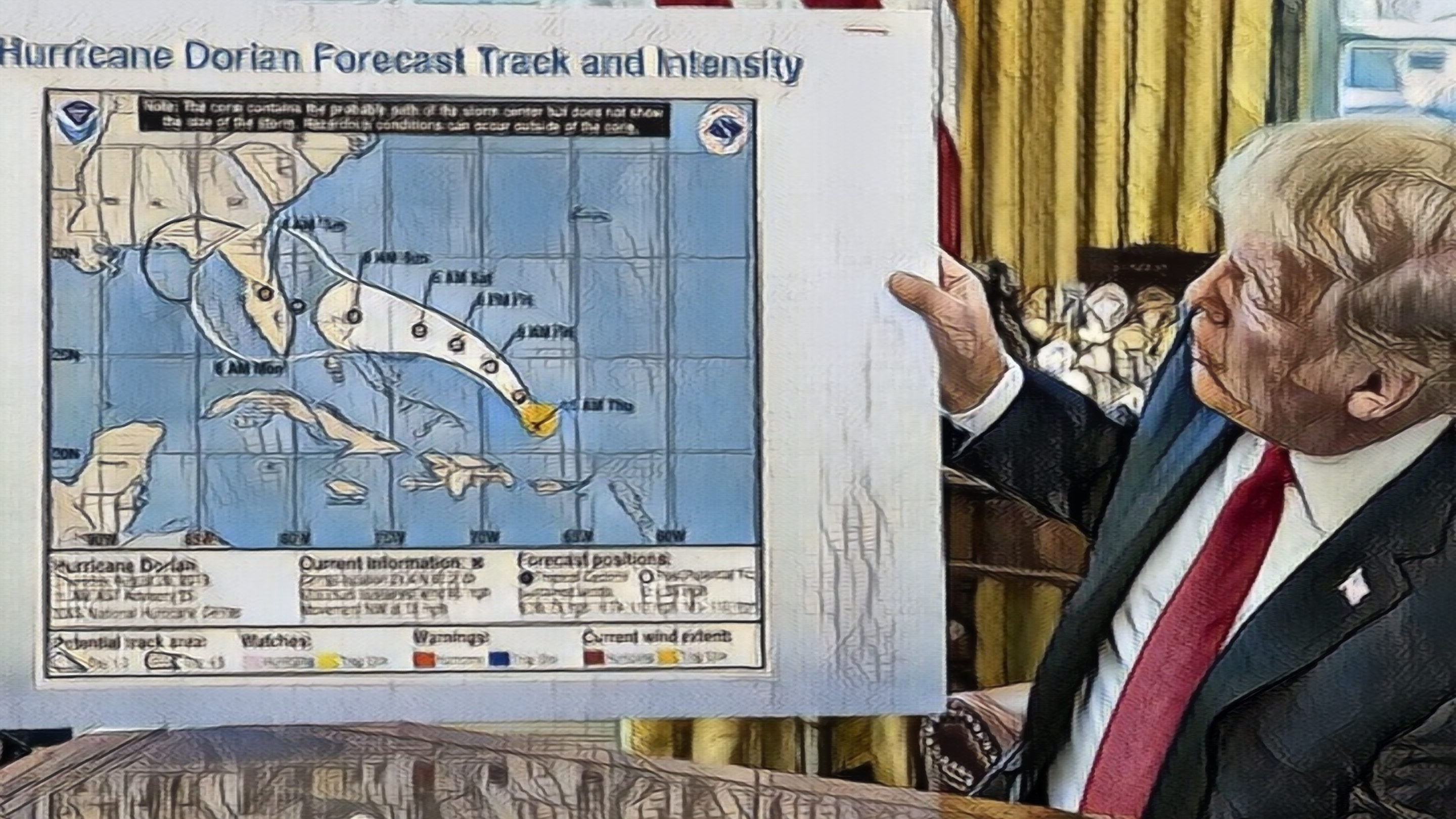
The radar hums a steady rhythm inside the Birmingham forecast office—green pulses circling stormless skies, fingers tapping keys, coffee cooling beside the console. On the morning of September 1, 2019, forecasters tracked Hurricane Dorian veering east of Florida. Then their phones lit up: a presidential alert claiming Alabama “will most likely be hit (much) harder than anticipated.”
Within minutes, the office responded with the digital equivalent of a sandbag wall:
“Alabama will NOT see any impacts from #Dorian. We repeat, no impacts…”
It should have ended there. But four days later, the President held up a hurricane map doctored with a black Sharpie to include Alabama—an image never issued by any forecast center. NOAA, under pressure from the Commerce Secretary’s office, released an unsigned statement supporting the altered map and criticizing the Birmingham team. The Commerce Department’s Inspector General later concluded NOAA’s actions “compromised [its] reputation for scientific independence.”
“When the map is wrong, the public is at risk.”
That moment, later dubbed Sharpiegate, was not an outlier—it was a signal. From 2017 to 2025, a pattern emerged: adjusting language, hollowing budgets, silencing scientists. Each move alone might seem procedural. Together, they reshaped the country’s capacity to anticipate and respond to disaster.
Ironically, the first steps were bipartisan wins. In 2017, President Trump signed the Weather Research and Forecasting Innovation Act, followed by the PROSWIFT Act in 2020. Both expanded NOAA’s modeling and warning systems. Meteorologists praised the measures for strengthening the “last mile” between research and public alerts.
But even as those laws passed, budget proposals told a different story. By 2018, the White House sought to cut NOAA’s funding by 16%, including a 32% reduction to its research arm. Sea Grant and other research programs were marked for elimination.