The Trump administration’s 2025 economic agenda is quietly overhauling how the government raises money—and who ends up paying for it. By reviving broad tariffs and pushing to extend the 2017 tax cuts, the policy mix shifts the burden down the income ladder while channeling benefits to the top. It’s not just unfair—it’s structurally regressive.
Tariffs have returned in force:25 percent on imports from Canada and Mexico, 10 to 20 percent on Chinese goods, plus expanded steel and aluminum duties. These taxes hit imported consumer products—electronics, groceries, clothing, auto parts—the staples most Americans rely on. Unlike income taxes, tariffs don’t scale with ability to pay. Everyone pays the same extra cost at checkout. That makes them especially painful for low- and middle-income households.
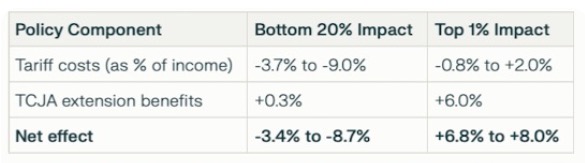
For lower earners, the numbers are brutal. Tariffs raise annual household costs by an estimated $1,200 to $2,600. For the bottom 20 percent of income earners, that’s equivalent to a 4 to 9 percent income tax. The reason is simple: lower-income households spend most of their income on goods. They can’t shift away from the things tariffs target. In contrast, the top 1 percent—who spend far less of their income on consumption—barely notice.
On their own, these tariffs would already be regressive. But they’re being paired with a permanent extension of the 2017 Tax Cuts and Jobs Act, which heavily favored the wealthy. That law cut corporate taxes, lowered top marginal rates, and chipped away at the estate tax. Extending it would lock in those benefits for high earners and large asset holders. The top 1 percent alone would walk away with nearly a quarter of the total gains.
The corporate tax rate, slashed from 35 to 21 percent, would stay low, feeding stock buybacks and shareholder payouts. Yet the overall cost to the federal budget is massive—about $4.5 trillion through 2034. While there’s talk of economic growth offsetting the loss, most of that growth flows to foreign investors and top earners, not American workers.
The combination of tariffs and tax cuts creates a clear transfer of wealth. Analysts from the Tax Foundation, Yale Budget Lab, and the Peterson Institute estimate the net effect: the bottom 20 percent could see their income reduced by up to 8.7 percent, while the top 1 percent sees gains of up to 8 percent. It’s a system that penalizes consumption and rewards capital.
And the damage isn’t limited to personal finances. Tariffs invite retaliation. When other countries hit back, U.S. exports suffer.