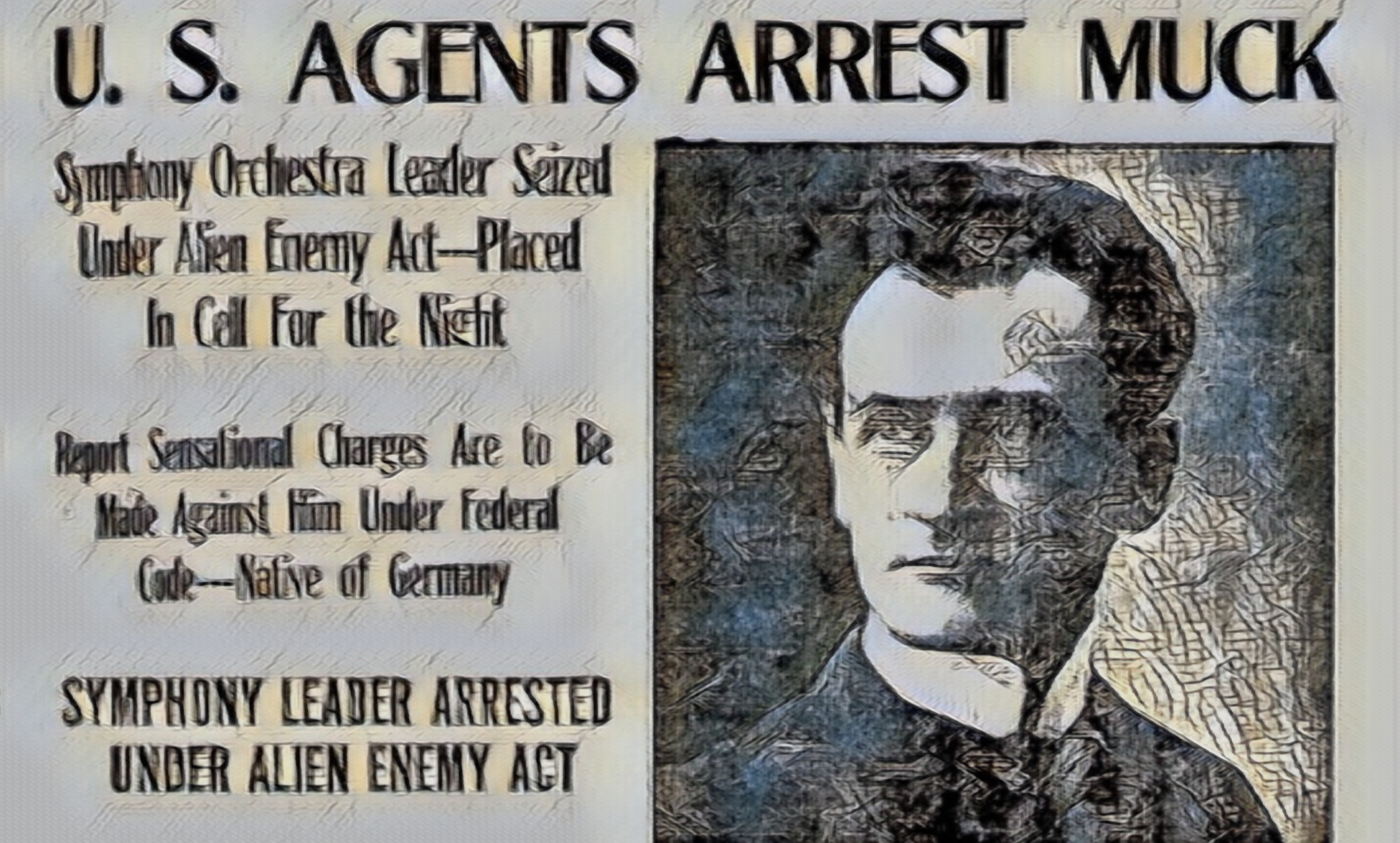
They came for the conductor in the middle of rehearsal. One moment Karl Muck was raising his baton in Boston Symphony Hall; the next, federal agents flanked him and led him out in silence. No charge. No warrant. Just war-born suspicion and an old law few remembered. March 25, 1918: the day music bowed to paranoia.
PULL-QUOTE: “He considered himself an American. But fear made him a prisoner of war in a country not at war with him.”
Muck, born in Germany but a Swiss citizen, was interned under the Alien Enemies Act of 1798—a relic that grants the president unchecked power over foreign nationals during wartime. America was at war with Germany. Muck conducted Wagner. That was enough.
He was sent to Fort Oglethorpe, Georgia, with thousands of others. Behind barbed wire, he rebuilt what had been taken from him. An orchestra. A stage. A kind of dignity. The prisoners called their camp "Orglesdorf." One recalled how the music, "rushed at us and carried us far above war and worry and barbed wire."
PULL-QUOTE: “The mess hall packed with 2,000 internees. Under Muck’s baton, the Eroica rushed at us.”
He stayed locked up a full year after the war ended. Deported in 1919, Muck told reporters: "I am not a German, although they said I was. I considered myself an American." But patriotism had already decided he wasn’t.
Fast forward to 2025.
On March 14, President Trump signed Proclamation No. 10903. It named Tren de Aragua—a Venezuelan gang—as an invading force. With that one word, "invasion," he triggered the Alien Enemies Act. No war declaration. No vote. Just a semantic grenade with legal consequences.