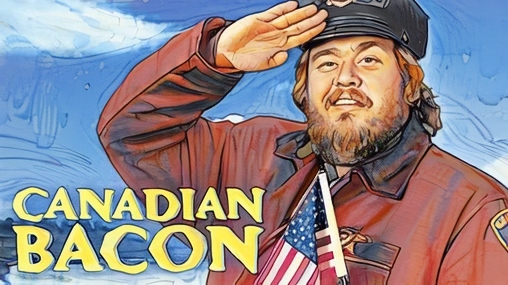
Cinematic history sometimes repeats, and sometimes it rhymes.
We’re still on vacation in Canada, tucked into an Airbnb on a rocky promontory overlooking the Atlantic. The wind is blowing, the rain keeps coming, and the surf is putting on a fine show. We’re not far from Peggy’s Cove, where yesterday we visited the quiet memorial to Swissair Flight 111.
I’ve met a few readers here who follow my articles—always gratifying—and I hope they’ll leave a comment or two. Canadians are remarkably well-informed about what’s happening in the U.S. They’re also deeply concerned. Many are watching Trump’s saber-rattling toward Venezuela and wondering, as I do, whether it’s really about drug routes—or whether Venezuela and Colombia are being eyed as the 51st and 52nd states. They do, after all, have some very nice beaches to develop.
That got me thinking about how dictators, or those who wish to be, often look for a war to boost support at home. And that, in turn, reminded me of a movie.
It started with the sound of hockey. Not the crowd—there wasn’t one—but the slap of a puck echoing off an empty metal bleacher in Niagara Falls, New York. Sheriff Bud Boomer didn’t even flinch. He was used to it, just like he was used to the jokes about Canada, the cutbacks to his department, and the new “threat assessment” briefing from the White House: they walk among us.
By the time Bud climbed into his squad car that morning, the U.S. was technically at peace but politically on fire. President Alan Alda—playing the unnamed commander-in-chief in Michael Moore’s Canadian Bacon—had poll numbers falling faster than a rust-belt bridge. His advisors, led by the smug James Allen (Kevin Pollak), had a plan: if you can’t win peace, manufacture war. Just not with anyone who might shoot back.
They chose Canada.
The justification came wrapped in flags and recycled Cold War fear.