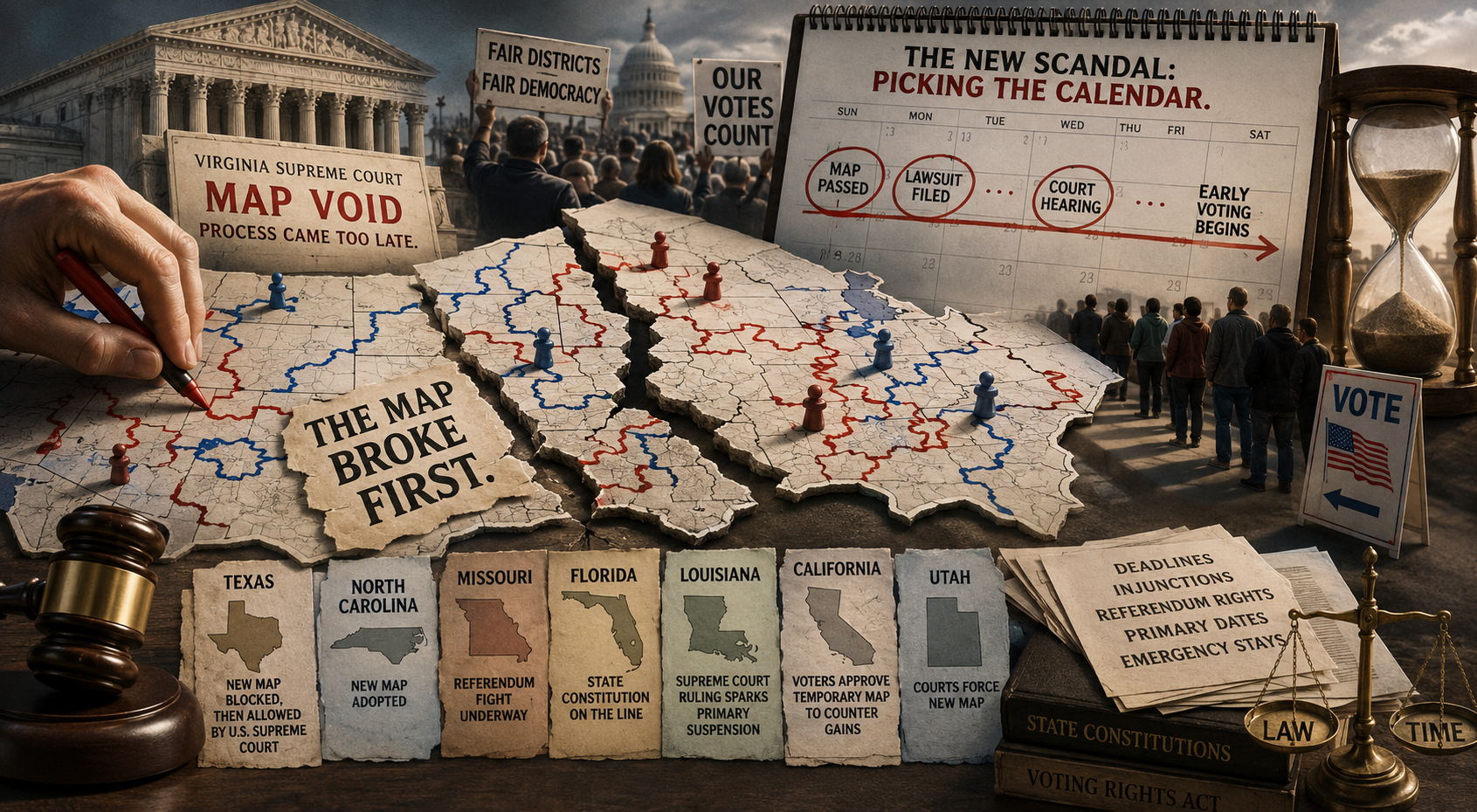
The election did not begin with a speech. It began with a line.
Not a line in a campaign ad. Not a line outside a polling place. A line on a map, moved a few miles one way, then another, until a voter became less a citizen than an ingredient. Enough of one kind here. Too many of another kind there. Mix carefully. Bake until November.
That was the old scandal of gerrymandering. Politicians picked their voters.
The new scandal is larger.
Now they are picking the calendar, too.
On May 8, 2026, the Virginia Supreme Court threw out a Democratic-backed congressional map that voters had approved by referendum. The decision did not say that mid-decade redistricting is always illegal. It did not say that voters are forbidden to approve a new map. It said something colder and narrower: the General Assembly had not followed Virginia’s constitutional procedure. The vote came too late. Early voting had already begun. The machinery was already moving. The map was void.¹
One week later, the U.S. Supreme Court declined to rescue it. On May 15, the Court rejected Virginia Democrats’ emergency request to reinstate the map, leaving the state court’s ruling — and the old congressional map — in place.²
That makes Virginia sound like a local procedural case.
It is not.
It is the latest turn in a national fight over whether congressional districts still belong to the census cycle, or whether they now belong to whoever can move fastest between elections.