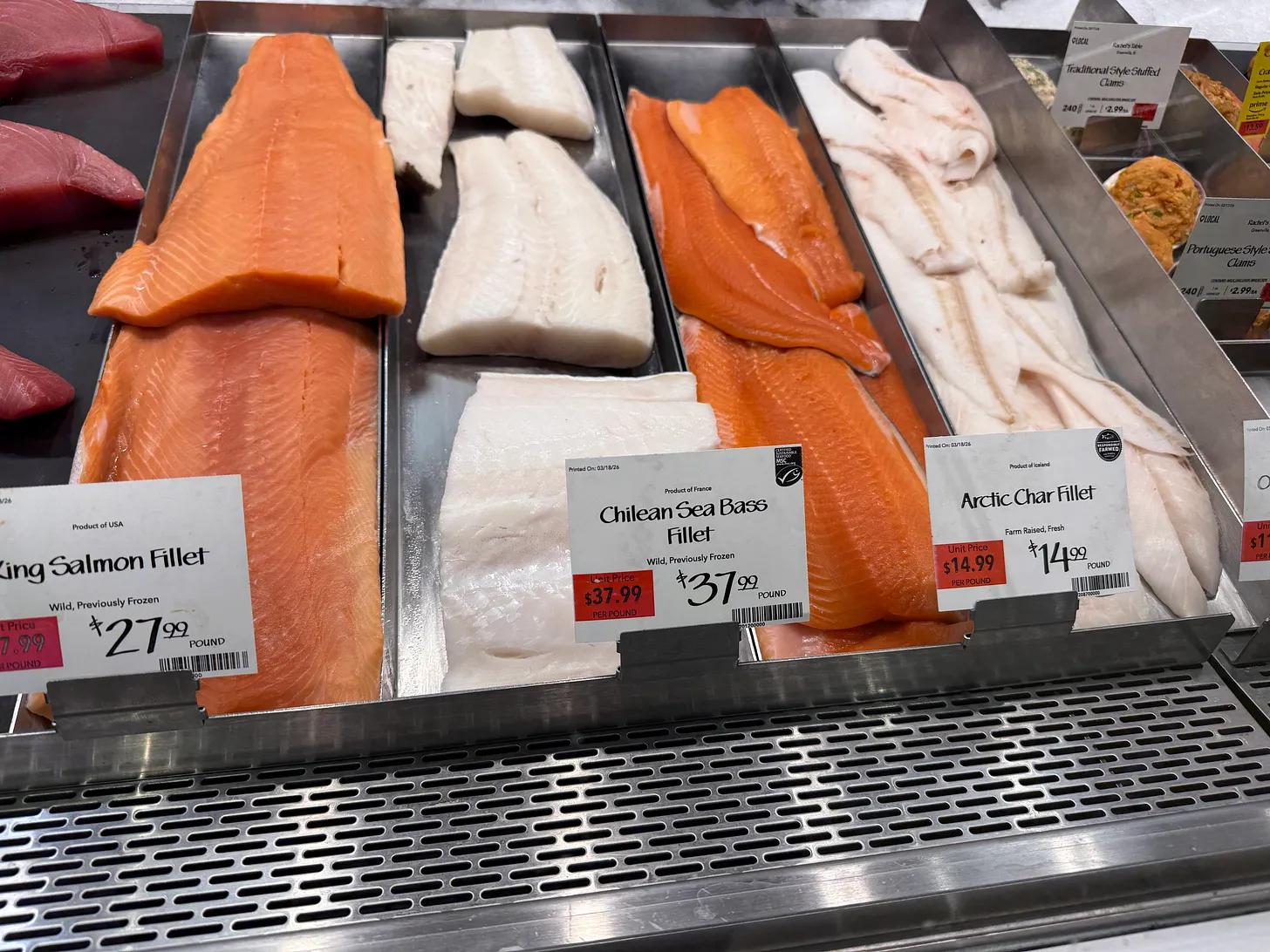
The counter at my local fish market on the seacoast has become a place where people pause.
Chilean sea bass sits at thirty-eight dollars a pound. Salmon beside it reads nineteen ninety-nine—still reasonable, but no longer casual. No one says anything. The man behind the counter keeps wrapping fillets in white paper. “People are still buying,” he said, not looking up, “just not the same fish.” Customers linger a few seconds longer, doing quiet arithmetic.
You don’t need a pound. A third of a pound per person puts dinner for two near fifty dollars before anything else touches the plate. That’s enough to change how the decision feels. Your eyes move a few inches down the ice. Salmon becomes a consideration. Hake appears at five seventy-nine. Same pan, same time, same act of cooking—one costs nearly seven times the other.
“Nothing disappears. It just moves.”
Food prices don’t move as one thing anymore. Groceries break apart the same way—beef, sweets, and coffee climbing, eggs falling, other staples barely moving.² Restaurant meals follow a different path, with full-service places climbing faster still.¹
The center of the meal has held. Chicken, rice, pasta, potatoes still feel familiar. It’s the range that’s shifted. The high prices are higher, and the lows are the same.
Beef climbed first. The U.S. Bureau of Labor Statistics says the average price for steaks across the country is $12.74 per pound. I don’t believe it—and neither does anyone standing at the counter.¹ Tenderloin pushes past forty. Chicken sits closer to $4. The gap isn’t imagined. It’s structural.