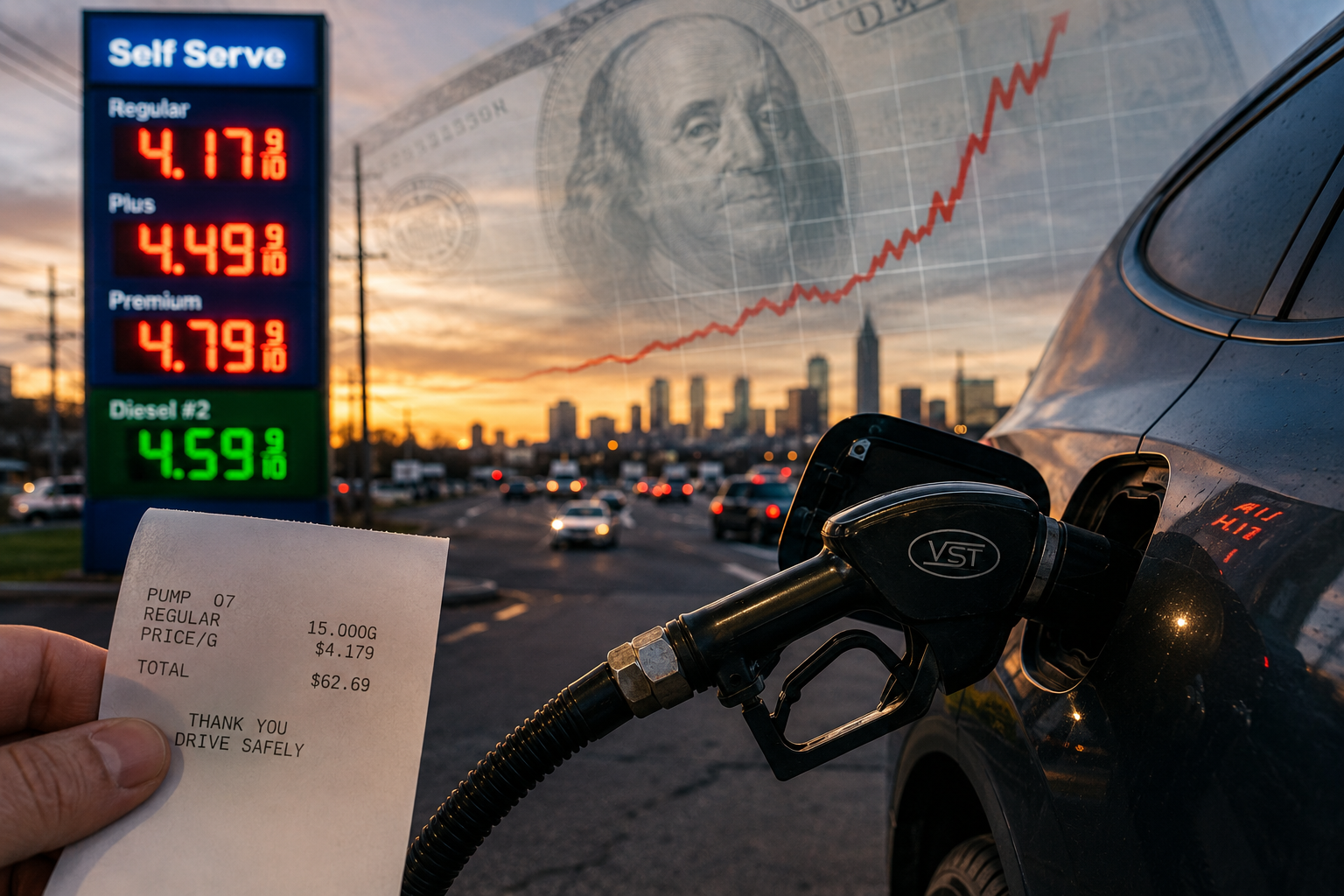
The receipt is thin enough to curl in a coat pocket, but it now carries more of the economy than it used to. A driver who buys fifteen gallons at $2.98 pays $44.70. At $4.50, the same fill-up costs $67.50. Nothing about that extra $22.80 looks like a policy decision, but if the car is filled twice a week, the household is suddenly paying nearly $200 more a month just to keep moving.¹
That is where the national economy becomes personal. A tax refund can arrive in April, the stock market can rise in May, and a government chart can still show growth, but the household does not live inside those abstractions. It lives inside the interval between paychecks, utility bills, grocery receipts, and the cost of getting to work. When gasoline takes a larger share of that interval, everything else has less room.
Economists describe the economy with a tidy formula: consumer spending, investment, government spending, and net exports. The notation, C + I + G + NX, has the elegance of a ledger, but the household economy is not elegant. Consumer spending accounts for roughly 70 percent of U.S. gross domestic product, which means the whole structure depends on people continuing to drive, buy, repair, travel, and absorb costs they did not choose.
That is why Jared Bernstein’s warning lands with more force than a routine forecast. The argument is not that recession is inevitable. It is that consumer spending can weaken when higher fuel prices, softer wages, and a cooler labor market press on the same household budget at once. Bernstein called the higher fuel cost a hit to disposable income, and the phrase is mild only if it stays on the page. At the pump, disposable income is the money that disappears before a family decides what else it can afford.