The Shot
Tech, Politics

The Shot

Apr 27, 2026

By the time we see what happened, we’ve already decided what it means.

I didn’t hear the shot as a shot.

What I saw first was the reaction.

It came through the television during the Correspondents’ Dinner, where the rhythm had already started to break, the tone shifting just enough that the interruption didn’t feel like a break so much as a continuation.

For a moment, it wasn’t clear what had happened.

Only that it had.

The program kept moving, as if the moment hadn’t decided what it was yet, and in that space—before anything settled—you could feel the explanation starting to form, not out of what had happened, but out of what it already fit.

Two days later, watching an interview on 60 Minutes, the same event returned in a different form.

Norah O’Donnell read aloud from notes left behind by the shooter, bringing it into the room slowly, deliberately, as if it might finally resolve into something you could hold onto. For a moment it did, suspended between what had happened and what it might mean.

Then, before the question had fully landed, the exchange shifted.

Donald Trump didn’t respond to the content of what she had read. He turned toward her instead, redirecting the moment away from the notes and toward the interaction itself, and in doing so changed what everyone was now watching.

Nothing new had been introduced.

Only the focus had changed.

The effect was immediate. The event receded. The exchange took its place.

That’s the break.

Events don’t settle the way they used to.

Once that process starts, interpretation doesn’t follow the event so much as compete with it.

I had seen the clip before.

Months earlier, during the last stretch of the election, when everything moved quickly and nothing seemed to stay in place for long. At the time, it didn’t feel finished. The sound arrived first. The reaction followed. It passed the way things moved then—before it had fully settled into anything.

Watching it again now, it was different.

By then, the moment had already been pulled apart and put back together into something that could be repeated, compressed into a sequence that seemed to settle on its own. On my phone, it unfolded quickly: the hand moved, the blood appeared, and the space between those two things closed in a way that didn’t require anything else.

I paused it at the same place each time without quite deciding to, holding the frame as if the stillness might settle something the motion hadn’t.

It didn’t.

It sharpened it.

Because once the moment could be stopped, it began to behave differently, shedding what didn’t fit inside the frame and holding onto what did, until the sequence carried a kind of closure it hadn’t needed when it was still happening. The hand was already there. The blood was already visible.

That version felt complete.

At full speed, it didn’t.

Watching it through without stopping, the motion loosened again. The sound came first. The reaction followed. For a moment, it opened back up into something that hadn’t decided what it was yet.

That version didn’t travel.

The tighter one did.

I sat there with the engine still off, the phone screen brighter than the windshield, and let the clip play through without stopping it, watching it move the way it had the first time—uneven, unresolved—until it felt closer to what I had seen then, if only briefly, before slipping again into something more complete.

The event itself had lasted only a few seconds, but by the time I was watching it again, the explanation had already moved ahead of it, settling into something clearer and more certain than the moment itself had ever been.

Once it reached that point, it was difficult to return.

Bibliography

The Wrong Kind of Winter
Climate, Economy

The Wrong Kind of Winter

Apr 25, 2026

What this fall’s super El Niño could mean for New England and Eastern Canada—a season where everything costs more to fix

The tide doesn’t have to roar into Portsmouth to make its point.

Some mornings it just arrives a little too high, stays a little too long, and pushes through a piece of infrastructure that was built for a different version of winter. A storm drain that used to empty into the Piscataqua reverses direction. Water comes up instead of going down. It spreads across the street, finds the low spots, and holds there longer than it should.

No one calls it a disaster. Not yet.

A few blocks get wet. A basement takes on water. Public works adds another item to a list that never quite clears. By afternoon the tide falls back, the street dries, and the town returns to normal, which is to say, it absorbs the cost and moves on.

That’s how this story works here. It doesn’t announce itself. It repeats itself.

Nothing fails all at once. It just keeps costing more to live the same way.

Out in the Pacific, the setup is taking shape. The trade winds weaken, the warm pool that normally sits piled up in the western Pacific begins to slide east, and heat stored in the ocean is released into the atmosphere. That shift reorganizes the jet stream—strengthening the southern branch, loosening the grip of Arctic air over the northern tier, and redirecting where storms draw their energy and moisture.¹²

El Niño is part of the system. It always has been.

What matters now is where it lands.

The background climate has already moved. The ocean is warmer than it was during the last major El Niño events. The atmosphere is holding more moisture. When the Pacific releases heat into circulation, it isn’t adding variability to a stable system. It’s amplifying one that is already carrying more energy than it used to.³

That difference shows up in small ways first.

In New England, winter still arrives. It just arrives unevenly.

Cold comes, but it doesn’t always hold. Snow falls, but it doesn’t always stay. A storm drops a foot, then another follows with rain that cuts through it. The ground freezes, thaws, and refreezes until the surface starts to fail. The snow that does fall carries more water and does more damage when it comes down.

It is still the same winter people recognize. It just behaves less predictably inside its own boundaries.

The pressure shows up in how tightly systems have to operate.

Skiing is a capital problem now. Snow can be manufactured, but only inside a narrowing temperature window. When that window closes—even briefly—the investment disappears and has to be rebuilt.

Maple production is a timing problem. It depends on a narrow rhythm—freezing nights, thawing days. When winter drifts warm, that rhythm breaks. The season still happens, but not reliably.

Municipal systems absorb what neither can control. Rain on snow moves water faster than drainage was designed to handle. Freeze–thaw cycles degrade roads faster than they can be repaired. Heavy, wet snow does more damage than powder ever did.

The pattern is familiar. What changes is how often it repeats.

In Boston, high-tide flooding events have increased more than fivefold since the 1950s.⁴ Insurance markets have already adjusted. In parts of coastal New England, homeowners have seen premiums rise by 20 to 30 percent in recent years—or lost coverage entirely—as risk is repriced.⁵

Farther north, in Portland and Portsmouth, the same pattern plays out at smaller scale: more water, more often, moving through systems built for less of both.

The ocean is part of that shift. The Gulf of Maine has been warming faster than most ocean regions on Earth—at times roughly three times the global average.⁶ That warmth feeds coastal storms and narrows the margin between routine weather and damaging events.

Across Canada, that margin narrows further.

In Halifax and across Prince Edward Island and Newfoundland, sea ice once absorbed winter storm energy before it reached the coast. When that ice forms later, or not at all, storms meet open water instead, building wave energy over longer distances and delivering it directly to shore.⁷

Inland, in Quebec, the same shift changes the timing of water itself. Hydropower systems depend on predictable accumulation and release—snowpack building through winter and melting steadily in spring. When more precipitation arrives as rain, runoff comes earlier and faster, forcing operators to manage variability instead of seasonality.⁸

New England depends in part on that system, and in January 2026 a Hydro-Québec transmission line stopped exporting electricity for roughly two days during a cold snap as Quebec prioritized domestic demand. The U.S. Energy Information Administration described the interruption as a stress test for the region’s winter energy system.⁹

A flooded street is a public works issue. Repeated flooding becomes an insurance issue. Repeated losses and rising repair costs begin to affect how a town borrows.

Moody’s and other rating agencies have begun incorporating climate exposure into municipal credit assessments, noting that repeated infrastructure damage and rising insurance costs can weaken local fiscal positions and, in some cases, contribute to negative outlooks or higher borrowing costs over time.¹²

The Pacific shifts. The storm track follows. Water moves differently. The cost shows up somewhere else—in a premium notice, a bond discussion, or a utility bill.

Which brings the story back to policy, and to the one place where the United States still has leverage before damage becomes debt.

The Federal Emergency Management Agency is built to respond to disasters, but just as importantly, to reduce them before they happen. Programs like BRIC—Building Resilient Infrastructure and Communities—fund drainage upgrades, flood protection, electrical hardening, relocations from hazard zones, and the unglamorous work that prevents small failures from becoming larger ones.

In 2025, that program was canceled. In 2026, a federal court forced its reinstatement, restoring roughly $1 billion in mitigation funding after billions in projects had been frozen or delayed.¹⁰

The interruption matters more than the headline.

Projects delayed are not neutral. A culvert not upgraded this year fails under next winter’s runoff. A drainage system left undersized becomes a recurring problem instead of a solved one. The cost doesn’t vanish during the pause; it compounds into the next season.

At the same time, staffing reductions—thousands of FEMA departures over the past year—have raised concerns about response capacity, not for a single catastrophic event but for the accumulation of smaller ones that require coordination, reimbursement, and follow-through.¹¹

The vulnerability isn’t failure. It’s strain—more things bending at once, more often, for longer.

A strong El Niño would not create that condition. It would align it—bringing a warmer ocean, heavier moisture, storm tracks that lean toward the East Coast, and winter patterns that are less stable than the systems beneath them were designed to handle.

The Pacific is where the signal begins, but it does not stay there. It moves through the jet stream, into the storms, into the snow that does not quite hold and the rain that arrives at the wrong time, into the water that moves faster than the drains can take it and the coastlines that take the hit without the buffer they once had.

By the time it reaches New England, it no longer looks like a climate event. It looks like a series of ordinary problems arriving out of sequence—wet snow on power lines, water backing through a drain, a repair that costs more than the last one, a budget that stretches a little further to cover it.

Most of it will be fixed. It usually is. The street dries, the slope turns green, the culvert gets replaced, and the next storm arrives on a system that is slightly more worn and slightly more expensive to maintain.

Nothing collapses. The town holds. The region holds.

But it does so on different terms than it used to, with less margin, more cost, and fewer places for the stress to go.

And when the next season begins, it doesn’t begin from where it once did, but from wherever the last one left it—carrying forward the damage, the repairs, and the quiet adjustments that have already been made.

Bibliography

Moody’s Investors Service — Climate risk in municipal credit assessments, 2024–2025.

Economy, Tech

The Brains We Left Behind

Apr 24, 2026

For a century, we rewarded one kind of mind. The next economy may reward the ones we left behind.

At 2:17 a.m., the emergency department at Portsmouth Regional Hospital slipped into that narrow, deceptive quiet that falls between surges. The machines didn’t stop. Monitors kept their rhythm, IV pumps clicked, a curtain shifted somewhere down the hall. It just felt, briefly, under control.

At the central station, a nurse wasn’t looking at the screens. She was watching the room itself—the way one patient shifted, the way another’s breathing landed just slightly out of sync with the numbers being displayed. Nothing dramatic. A fraction. The kind of mismatch you miss if you’re watching the chart instead of the person.

She walked into the room before the alarm sounded.

Later, the chart would compress it into a sentence: “patient deterioration noted prior to monitor escalation.” Clean. Precise. Technically correct. It doesn’t capture how the signals actually arrived—simultaneous, overlapping, resolving into a decision without steps in between. When she tried to explain it, she shrugged. “It’s pattern,” she said. “You don’t go one, two, three. You just know when something’s wrong.”

That ability doesn’t make her an easy employee.

It makes her a great nurse.

The system she works in doesn’t quite know what to do with that distinction. It tracks compliance, timing, documentation, protocol—the visible parts—while the thing that brought her into that room sits outside all of it, hard to standardize, harder to train, and almost impossible to audit. Over time, that gap matters, because what a system measures is what it learns to preserve.

You can see the same gap much earlier, long before anyone steps into a hospital, in a classroom outside Manchester where a student’s file sits on a desk with a pattern that has repeated for years: strong test scores, missing assignments, comments that circle the same idea in different language—bright but inconsistent, easily distracted, needs to apply himself. He has just been diagnosed with ADHD.

Nothing about him changed.

Only the explanation did.

School is built around a particular kind of work—sit still, focus on one thing, follow the steps, finish the task—and those are useful skills. They’re also very specific ones, shaped by the kind of world that needed them. About 150 years ago, most work didn’t look like this. Then factories arrived, and everything tightened. Work became repeatable, structured, timed. The economy needed people who could show up, stay on task, and do the same thing the same way, over and over, and schools followed that need with rows of desks, fixed schedules, one subject at a time, and one correct answer.

It worked long enough to feel inevitable.

It scaled well enough to become invisible.

And it sorted people.

If your brain matched that structure, things felt natural. If it didn’t, things got harder—not because you weren’t capable, but because you didn’t fit the system that defined capability in the first place. That sorting held because the economy reinforced it. Employers paid for consistency, compliance, and repeatability, and the labor market reflected that preference with almost mechanical precision.

Now that reinforcement is weakening—not disappearing, but weakening—and the reason is mechanical. Over the past decade, a growing share of routine cognitive work has been absorbed by software. McKinsey estimates that up to 60% of current jobs have at least 30% of tasks that are technically automatable, and the tasks that go first are the ones that are predictable, structured, and repeatable. This isn’t a cultural shift or a change in taste; it’s a supply shock, and supply shocks don’t negotiate.

They reset prices.

When the supply of “routine cognition” explodes, its value drops. The market doesn’t argue with that. It absorbs it, adjusts, and moves on—slowly at first, then faster as the edges begin to fold inward.

You can see that repricing most clearly in places where the job remains but the center of the work has shifted. In a law office in Boston, a junior associate described how his role used to involve long hours reading documents line by line, careful and repetitive, the kind of work that rewarded endurance more than judgment. Now software handles much of that first pass. “I’m not reading everything anymore,” he said. “I’m figuring out what’s wrong.”

That’s not a smaller job.

It’s a different one.

A cab driver in Manchester described the same underlying skill from a different vantage point. After years on the road, he doesn’t track individual cars so much as the pressure between them—how traffic builds, where it releases, when someone is about to move before they commit. “If I have to think it through, I’m already late,” he said, describing pattern recognition operating just ahead of conscious explanation.

That doesn’t show up on a résumé.

It prevents collisions.

For a long time, abilities like that lived at the edges of the economy—useful, sometimes critical, but not central—because the center was built on repetition, structure, and control. That’s what we trained for, and that’s what we rewarded. As machines absorb more of that work, the center doesn’t disappear, but it hollows out, and the value begins to migrate toward what remains difficult to automate: judgment, synthesis, anomaly detection, and the ability to work with information that doesn’t resolve cleanly.

This is where the reframing of neurodivergence begins to matter in a practical sense. The underlying traits haven’t changed, but the environment they operate in has, and with it the balance between cost and contribution. ADHD, in a system built on low-stimulation, delayed-reward tasks, looks like a deficit. Research by Nora Volkow at the National Institute on Drug Abuse shows that those brains don’t engage as strongly with that kind of work. In environments where signals change quickly and decisions carry immediate consequences, that same sensitivity can become an asset—not universally, and not without cost, but in ways that are increasingly relevant.

Autism shifts the lens again. The difficulty is often with ambiguity and shifting social expectations, but the strength lies in systems—seeing structure, tracing logic, finding where something breaks. Researchers like Simon Baron-Cohen at University of Cambridge have documented that profile for years, and it becomes more valuable as systems grow more complex and less transparent.

Dyslexia follows a similar pattern in a different direction. Reading may be slower, but pattern recognition across space and structure is often stronger. Work summarized from Maryanne Wolf and observations from NASA point to the same trade-off.

Different wiring.

Different payoff.

But this is where the clean version of the story breaks.

The system doesn’t want this shift.

Standardization isn’t just efficient—it’s enforceable. It makes performance legible, outcomes predictable, and people interchangeable enough to manage at scale. Schools, corporations, and bureaucracies aren’t neutral observers of this transition; they are built on the logic that’s being disrupted, and that logic still works well enough to defend itself.

So the result is not a broad revaluation of cognitive difference. It is something narrower and more uneven. The traits that map cleanly to high-value roles—pattern recognition in AI oversight, system analysis, edge-case detection—get pulled upward, often into specialized or elite positions, while the rest remain embedded in systems that still reward predictability and compliance.

That’s not inclusion.

That’s selection under new rules.

What emerges isn’t the end of sorting. It’s a reshuffling—one that elevates certain forms of difference while leaving the underlying structure intact. The system learns to extract value from variance without needing to accommodate it broadly.

Some people adapt to that shift. Others are filtered out faster as the margin for mismatch narrows. Many end up caught between systems, misaligned with the old one and not yet recognized by the new one.

That tension isn’t a bug.

It’s the transition itself.

Back in the classroom, the student with the missing assignments solves a problem in a way that doesn’t follow the steps but still reaches the answer. The teacher pauses—not because it’s wrong, but because it doesn’t fit the expected path—and in that pause you can see the system trying to decide what matters more, the method or the result.

That moment is easy to overlook.

It shouldn’t be.

Because what looks like a small mismatch in a classroom is the same mismatch playing out across the economy. For a century, we selected for people who could follow the system. Now we’re building systems that do that better than we can, and we haven’t decided—at scale—what replaces it.

That might not make him the easiest student to teach.

It might make him the kind of mind the next system depends on.

Or it might mean the system adapts just enough to use him—

and keeps calling everyone else like him the problem anyway.

Bibliography

Tech, Climate

Nuclear to Mars

Apr 24, 2026

NASA’s shift from explosive thrust to continuous power—and what it makes possible

The checklist sits on a second monitor, half-hidden behind a telemetry window, while Alvarez leans back just far enough to see both without moving his chair. He came over from propulsion analysis five years ago, after a launch scrub that turned on a valve fault no one had modeled correctly, and he still keeps that report in a folder he doesn’t open. The spacecraft is already two days out, coasting on the last chemical burn, and the line he’s watching for is unremarkable: reactor enable, conditional.

He doesn’t say anything when it clears. He marks the time, then waits through the lag that always follows commands sent across that distance, long enough for doubt to creep in before the data returns and settles where it should.

“You don’t celebrate this step,” he says later. “You verify it, because if it’s wrong, you won’t get a second try.”

What changes in that moment doesn’t register as a spike or a surge. It shows up as continuity. Heat where there was none, electrical load that doesn’t decay, a thrust profile that begins and does not end. The spacecraft stops behaving like something that was thrown and starts behaving like something that works.

Call it a small thing—the difference between a push and a process—but it changes what the rest of the mission is allowed to become.

Alvarez learned his instincts on chemical systems, where propulsion is a short, decisive conversation with physics. You burn propellant, you get your delta-v, and then the system goes quiet, leaving guidance and small corrections to carry you the rest of the way. It is elegant and brutally constrained at the same time. You can reach a destination with precision, but you arrive with whatever you managed to pack at the beginning, no more and no less.

“We got very good at leaving,” he says, glancing back at a trajectory plot that is already obsolete. “Staying is a different problem.”

The reactor changes that problem by changing what the spacecraft does with time. Instead of converting fuel directly into thrust, the system converts heat into electricity and electricity into motion, feeding a set of thrusters that produce almost no force at any given instant. The force is slight enough to vanish into rounding errors over short intervals, which is why the curve the navigation team watches looks almost flat until it doesn’t.

A specialist on that team keeps a printout pinned to the edge of her console, the kind of chart that invites skepticism because it looks too gentle to matter. “It’s not acceleration the way people think of it,” she says, running a finger along a line that bends upward by degrees. “It’s accumulation. Leave it alone long enough, and it outruns what you expect.”

That curve shows up early in the mission design, shaping everything that follows. Once you commit to sustained low thrust, you commit to a different allocation of mass and risk. You carry less propellant, because you don’t need to spend it all at once, and you carry more capability, because the system that produces your motion also produces your power. The spacecraft becomes less like a projectile and more like a platform.

The first consequence is physical. If you are not devoting most of your mass to propellant, you have room for payloads that do more than observe and transmit. In NASA’s case, that includes helicopter scouts for Mars, small enough to travel as secondary cargo but capable of mapping terrain, identifying landing zones, and probing for subsurface water once they arrive.

The second consequence is temporal. A reactor that produces steady electrical output does not care whether the Sun is available, whether dust is in the air, or whether the environment aligns with your operating window. On the Moon, where night lasts roughly two weeks, solar systems shut down or rely on storage that adds mass and complexity. On Mars, dust storms can reduce solar output to a fraction of nominal levels for extended periods. A reactor continues.

“Power is what lets you make commitments,” an engineer working on surface systems says. “Without it, everything is provisional.”

The propulsion work feeds directly into the question of sustained presence. If you can launch, start, and operate a compact reactor in deep space, you have demonstrated a power system that can be set down on a surface and left to run through conditions that defeat alternatives.

In Idaho, where teams are developing what the Department of Energy classifies as microreactors, the target is not a city but a constraint. Diesel fuel that has to be shipped in over long distances, at costs that can exceed three hundred dollars per megawatt-hour in remote locations, defines the operating limits of entire communities and industrial sites. Replace that with a compact reactor that can run continuously for years, and the constraint changes character.

A project manager there, standing beside a mockup that occupies less space than most people expect, frames it in terms that echo the space program without trying to. “We’re trying to make nuclear behave like equipment,” she says, tapping the side of the unit. “Something you deliver, install, and depend on.”

Current designs aim for outputs in the range of a few to tens of megawatts electric, with refueling intervals measured in years and footprints small enough to be transported in modular sections. They do not replace centralized generation, but they change the arithmetic wherever the alternative is a fuel chain that can be interrupted, delayed, or priced beyond what the site can absorb.

In space, reactors are being scaled to the smallest viable systems that can support propulsion and survival beyond Earth orbit. On Earth, they are being scaled to the smallest viable systems that can be deployed where centralized infrastructure does not reach.

That is where the conversation turns, almost inevitably, to fusion.

A physicist who has spent much of her career on confinement systems answers the question without embellishment. “First you get a plasma that sustains itself,” she says. “Then you get net power. Then you get materials that survive. After that, you can talk about form.”

The order matters. Controlled reactions have been demonstrated, but continuous, economically viable operation requires maintaining extreme temperatures, sufficient particle density, and confinement long enough to produce more energy than is consumed, all while managing neutron flux that degrades structural materials and complicates fuel cycles. Each requirement is a boundary condition. Together, they define a system that has yet to stabilize.

Even if those hurdles are cleared, the path to smaller systems introduces its own constraints. Shielding does not shrink without consequence. Fuel handling imposes additional requirements. Thermal management becomes more difficult as systems compact.

“We’re still proving the plant,” she says. “Portability is a different conversation.”

NASA is not ignoring fusion. It is building with what can be engineered, tested, and flown within a timeframe that intersects with policy, budgets, and mission windows. Fission offers that path, along with a set of challenges that are understood well enough to manage, if not eliminate.

Those challenges introduce tension that does not show up in the clean lines of a trajectory plot. Launching a reactor requires approvals that extend beyond engineering into regulatory review and public scrutiny that have historically slowed or stopped similar efforts. Cost projections still compete within a budget environment that shifts with political cycles. Integration risks remain, particularly when adapting hardware originally designed for different roles.

None of that is visible in the data Alvarez watches.

By the time he closes his console, the numbers have settled into a pattern that no longer surprises him. The power draw is stable. The thrust profile matches the model within tolerances that would have been questioned a decade earlier.

He lingers a moment longer than he needs to, watching a line that moves slowly enough to resist interpretation, aware that its significance lies in what it will look like weeks from now rather than in what it shows tonight.

“This is the part that matters,” he says. “The part where it doesn’t stop.”

Outside, nothing marks the change. No light, no sound, nothing that would suggest a system has shifted from impulse to duration. Far beyond that horizon, a machine is still adding to its velocity, one quiet increment at a time.

Bibliography

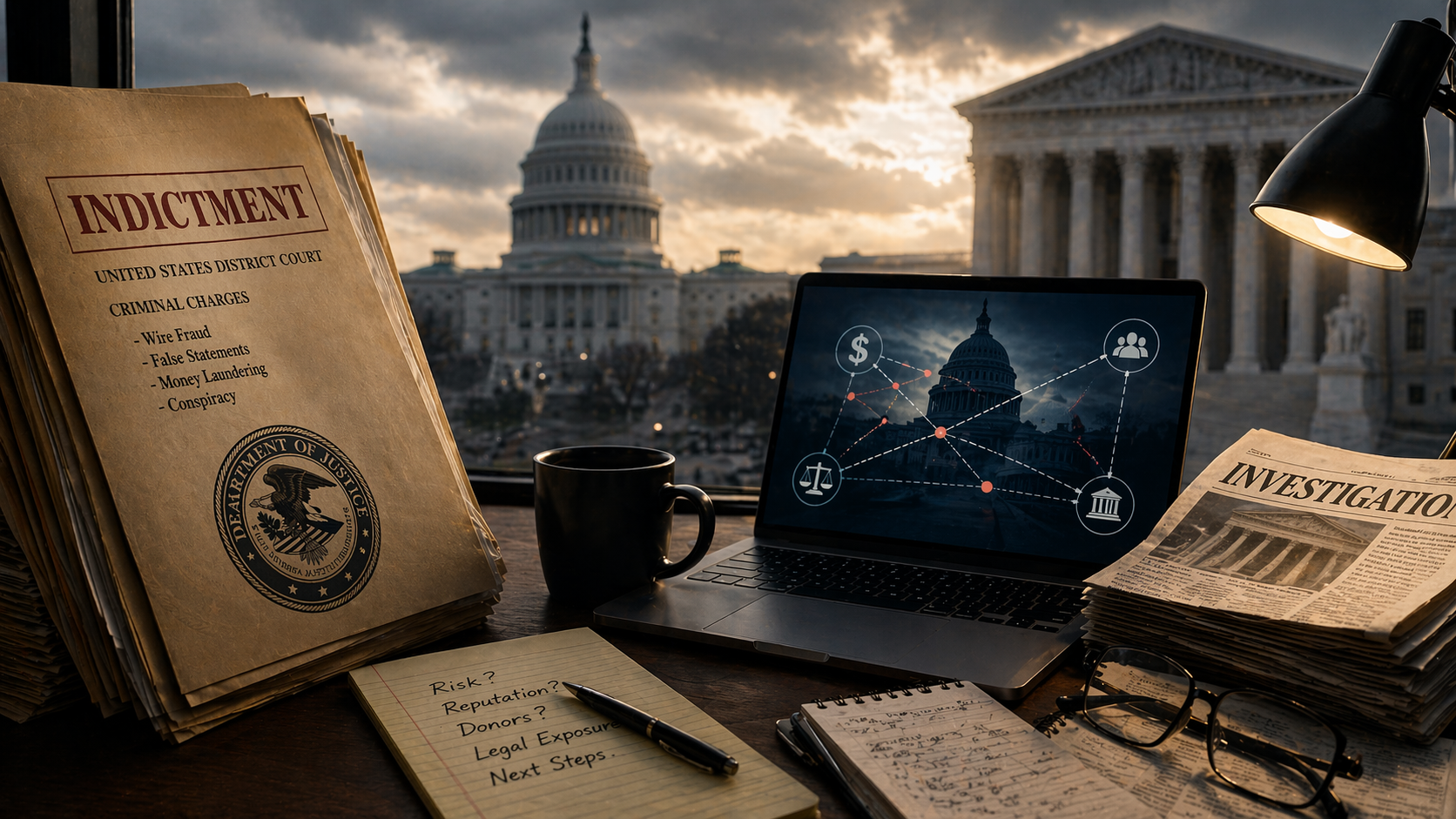
The Indictment Effect
Politics, Economy

The Indictment Effect

Apr 23, 2026

How legal exposure is reshaping decisions across politics and civil society

The envelope was heavier than it needed to be, thick cream stock with a return address that looked routine enough to ignore, which is why he left it on the corner of the kitchen table while the coffee machine finished its slow grind and the morning settled into its usual rhythm.

He had just come back from his walk—same route, same pace, the same half-read headlines glowing on his phone—and nothing in the room suggested anything had changed, yet the envelope drew his attention in a way that made it feel less like mail and more like something that would alter how the rest of the day unfolded.

When he opened it, the language was careful, advising caution around future donations to the Southern Poverty Law Center, an organization he had supported for years without much deliberation, the kind of support that becomes automatic when the institution itself feels stable.

The letter referenced a federal indictment announced on April 21, 2026, and the possibility of financial exposure tied to allegations that the organization had concealed how certain funds were used, and although it did not tell him what to do, it changed the context in which any decision would now be made.

“I don’t know what’s true anymore,” he said later, not as a declaration but as a recalibration, the kind that happens when familiar categories begin to blur.

The indictment itself is specific. According to the Department of Justice, a grand jury charged SPLC with wire fraud, false statements to a federally insured bank, and conspiracy to commit money laundering, alleging that from roughly 2014 through 2023 the organization routed more than $3 million through intermediaries to individuals associated with extremist groups while representing those expenditures in ways prosecutors say misled donors and financial institutions, as described in the DOJ’s April 21 filing.¹

That is not an argument about whether informants were used. Federal law enforcement has long relied on confidential human sources in investigations involving organized crime and domestic extremism, a practice courts have upheld when properly documented and disclosed. The government’s theory instead rests on whether SPLC’s internal handling and external description of those payments crossed into misrepresentation, which is a narrower and more testable claim.

The case also turns on how narrowly those payments are interpreted—whether as isolated transactions or as part of a broader effort to infiltrate and dismantle extremist groups, a distinction legal analysts have flagged as central to how a jury might evaluate intent and disclosure.

In announcing the charges, the Justice Department said the case involved “a scheme to conceal the true nature of financial transactions and mislead donors,” placing the burden on documentation rather than narrative.¹ The organization, for its part, has said the payments were tied to longstanding intelligence-gathering practices designed to monitor violent groups, a defense that will ultimately be weighed against the government’s claims in court.

Some legal commentators have also pointed to factual disputes within the indictment itself, including questions about how certain extremist groups are historically characterized, issues that may not determine the outcome but could affect how the case is evaluated in court.

He set the letter down and reread the indictment summary on his phone, noticing how precise it was, how little it said beyond what could be charged, and yet how much it changed the way he thought about a donation he had never previously reconsidered.

The question in front of him was not legal. It was behavioral.

The context for that behavior had already been shaped by other cases he had followed, some closely, others only at the level of headlines that linger longer than their details.

In New York, Attorney General Letitia James—who had previously secured a civil judgment against Donald Trump for business fraud—was indicted in 2026 on mortgage-related charges tied to property disclosures. The case drew immediate national attention because of her role as a political adversary, but it also ran into early challenges, including disputes over evidence and procedural issues that complicated the prosecution’s path forward.

James denied wrongdoing and described the case as politically motivated, a claim that remains contested, yet the status of the case—charged, then weakened before trial—created a data point that was difficult to categorize cleanly. According to legal analysts cited in coverage at the time, fraud cases tied to disclosure disputes often hinge on proving intent, a standard that historically leads to mixed outcomes even outside politically exposed cases.²

That context does not resolve the question of motive, but it does place the case within a broader baseline where not all such prosecutions succeed, making its trajectory informative without making it definitive.

He folded the letter once and left it on the table, aware that he was now reading the SPLC case through a lens shaped by outcomes as much as allegations, noticing not just what had been charged but what had happened after charges were filed.

The same shift in attention appeared in reporting from 2025, when the administration directed the Justice Department to examine ActBlue, the primary processing platform for Democratic political donations, in an inquiry tied to campaign finance compliance and the handling of small-dollar contributions.

Public reporting indicated that the probe was initiated through executive direction and focused on whether the platform’s processing systems adequately verified donor identity and complied with Federal Election Commission requirements under existing campaign finance law, including donor verification and reporting provisions codified in federal statute.³ The statutory hook is well established, yet the scope of the inquiry placed a central piece of political infrastructure under scrutiny.

As of the latest reporting, the investigation had not produced criminal charges, but its presence introduced uncertainty into a system that had previously been treated as routine, affecting campaigns, donors, and vendors who relied on it.

Bradley A. Smith, a former chairman of the Federal Election Commission, has noted in public commentary that enforcement patterns in campaign finance often influence behavior before penalties are imposed, as participants adjust to perceived regulatory risk rather than waiting for formal findings.⁴

Back in the kitchen, he scrolled through those earlier stories, noticing how the details differed while the effect felt similar, not as a pattern he could prove but as a set of conditions that altered how decisions were made in advance of certainty.

The mechanism does not require coordination to function. It operates through visibility and repetition, where the presence of an investigation—especially one tied to a politically exposed target—changes the perceived cost of adjacent actions, even when the legal outcome remains unresolved.

That effect may extend beyond donors and institutions to individuals operating closer to the source of information. By describing sources and their roles in detail, the indictment introduces questions about how visible cooperation with civil society organizations might affect individuals embedded in extremist groups, a factor that could influence future willingness to provide information.

That dynamic is not unique to politics. In regulatory environments, firms routinely adjust behavior based on the direction of enforcement rather than waiting for penalties, a process documented in regulatory enforcement literature, including studies published in journals such as the Journal of Law and Economics, where scholars have described anticipatory compliance as a response to perceived enforcement risk rather than adjudicated outcomes.⁵

“The signal is often enough,” as that literature suggests. “You don’t need a conviction to change behavior; you need a credible possibility of exposure,” a principle that explains why decisions shift even when outcomes remain uncertain.

He looked at his checkbook, still in the drawer where it had always been, and closed the drawer without taking it out, aware that the decision had shifted from routine to conditional, even though none of the facts in his own life had changed.

The SPLC case will proceed through the courts, where the allegations about financial disclosure and intent will be tested against evidence, and it may ultimately stand or fall on whether prosecutors can substantiate their claims about concealment and misrepresentation.

The James case may resolve in a way that clarifies whether it was a legitimate prosecution that faltered or a weak case that should not have been brought. The ActBlue investigation may produce findings, charges, or nothing at all, depending on what investigators can establish under existing law.

Each of those outcomes will matter on its own terms, and none of them alone defines a system.

But before those outcomes arrive, the conditions they create are already influencing behavior, shaping decisions in ways that are difficult to measure but easy to recognize once they occur, as individuals and institutions adjust not to what has been proven but to what might be.

He picked up the letter again and placed it back in its envelope, not because the question had been resolved but because it had changed form, shifting from a matter of support to a matter of assessment.

Outside, the street moved as it always had, unchanged in any visible way, while inside the calculation continued, quieter than the headlines but more persistent.

“Nothing stopped,” he said later, trying to describe the difference. “It just stopped being automatic,” and in that shift—from assumption to evaluation—the effect had already taken hold.

Bibliography

Politics, Tech

Judge Hurley’s Revenge

Apr 23, 2026

How a Procedural Ruling Collided With a Statewide Vote—and What Comes Next

The line started before the doors opened, a loose arc of people holding coffee and folded sample ballots, shifting their weight against the chill as poll workers unlocked the glass entrance in Fairfax County. A man in a navy windbreaker—mid-50s, the kind of person who reads the ballot twice before filling it in—checked his phone again, not for news, but for the wording of the question he’d already read twice, the phrase that had been sticking with him since early voting began.

“Restore fairness.”

He said it quietly, not as a slogan but as a test, then stepped forward when the line moved.

What he was voting on had already been argued in court, dissected in legislative sessions, and sharpened into competing narratives, yet the underlying move was mechanical and precise: Virginia was trying to change when maps are drawn and who draws them. Timing and control, not ideology, were the levers, and once those levers shift, everything downstream begins to move with them.

Virginia had spent years trying to step away from that dynamic. In 2020, voters approved a constitutional amendment creating a bipartisan redistricting commission, splitting authority evenly between Democrats and Republicans so that neither side could unilaterally shape districts to its advantage. The system was intentionally rigid, tying map-drawing to the census cycle and locking those maps in place for a decade, which forced political competition to happen inside fixed boundaries rather than around them.¹

The new amendment, the one on the ballot that morning, temporarily suspended that arrangement. It would return map-drawing authority to the General Assembly for a defined period before handing it back after 2030, a narrow window aligned with the next few election cycles. Control would shift just long enough to matter, which is what made the change feel less like structural reform and more like a targeted extension of the cycle itself.

A woman two places behind him in line, bundled in a long gray coat, leaned toward a friend and spoke in the low, practical tone people use when they’ve already made their decision but still feel the need to justify it.

“We have to fight fire with fire.”

She wasn’t quoting a strategist. She was describing a system that had already started to move.

Across the country, redistricting had begun to loosen from its once-per-decade rhythm and take on a more flexible form, where advantage depends not only on how lines are drawn but on when they can be redrawn. In states like Texas and North Carolina, aggressive partisan maps had already reshaped congressional representation, and the gains from those maps were immediate and measurable in seats.³ That created a simple pressure: timing becomes part of the strategy, not just the outcome.

Virginia’s amendment didn’t introduce that pressure; it responded to it.

When the votes were counted, the margin was narrow but decisive, enough to move the amendment forward and open the door to a congressional map that could reshape representation within a single election cycle.⁴ For a brief moment, the result looked settled, the way election outcomes usually do once ballots are processed and numbers stabilize.

Then Judge Jack S. Hurley Jr. intervened, not to evaluate the map itself, but to examine the sequence that produced the question.

The Virginia Constitution requires amendments to move through a defined order—legislative approval, an intervening House election, approval again, and then submission to voters—which functions as a timing constraint. That structure forces proposed changes to pass through an election before reaching the ballot, limiting the ability of a single political moment to rewrite structural rules.⁵

Hurley concluded that constraint had been compressed. Early voting for the required election had already begun before one of the legislative steps was completed, placing the process inside the election it was meant to precede. He also cited the ballot language, where “restore fairness” framed the measure in a way that moved beyond neutral description.

Those findings stopped certification.

The response came from a different direction, anchored less in sequence than in scale.

“Voters’ voices should not be overridden…” — Jay Jones

That argument treats the referendum as the decisive event, emphasizing participation and outcome over the procedural path that led there. Millions of voters answered the question as presented, and invalidating that answer reframes elections as conditional, particularly when the challenge comes after ballots have been cast and counted.

Supporters also note that the structural change was disclosed. The ballot described a temporary transfer of redistricting authority to the legislature before a return to the commission, which means the mechanism was visible even if the framing was not neutral.²

Opponents of the amendment locate legitimacy earlier in the process.

“The Constitution is clear, and the General Assembly ignored it.” — Jason Miyares

In that view, early voting is not a prelude; it is part of the election itself. Once ballots are being cast, the constitutional sequence is no longer theoretical, and any step taken during that period collapses the separation the process is designed to enforce.

Governor Glenn Youngkin framed the same concern in structural terms, describing the effort as an attempt to “short-circuit the Constitution,” which shifts attention away from immediate outcomes and toward the durability of the rules that govern them.¹⁰

That divergence—outcome versus sequence—marks the point where the arguments separate.

One side measures legitimacy at the ballot box, where participation resolves the question. The other measures it in the architecture leading up to that moment, where adherence to process determines whether the question was valid to begin with.

What gives the case weight beyond Virginia is not the map it might produce, but the behavior it signals. If mid-decade redistricting becomes a repeatable response to perceived imbalance, the ten-year cycle stretches in practice, even if it remains fixed in law.

In a small set of unified-control states—where one party holds the legislature and can sustain a redraw through expected litigation—this logic would allow additional redraws before 2030, effectively converting a decennial system into a conditional one. The incentive shifts immediately: maps become instruments that can be recalibrated, timing becomes a strategic variable, and each adjustment invites another.

Back in Fairfax County, the man in the navy windbreaker fed his ballot into the machine and waited for the confirmation screen, watching for the brief pause that signals acceptance. He didn’t know whether the amendment would survive the courts, or how the arguments would resolve, but he understood that the question he had answered was not finished.

He had voted on a map.

The system was now deciding how often that map could change.

Bibliography

Find articles