More than 450 million people can move through the Schengen area without routine internal border controls. Millions cross those internal borders daily for work, study, family, and ordinary life.⁸
Europe moved trust inward and enforcement outward.
At the Haskell, the movement is the other way. Enforcement has entered the choreography of a town library.
The June 10 ceremony will be real. There should be gratitude. The new entrance means Canadian patrons can enter from Canada again. It represents labor by trustees, staff, donors, contractors, preservation officials, and residents who refused to let the building become unusable for half its community.
But a ribbon-cutting can make loss look like completion.
The speeches will call it restored access. The photographs will show the new door. The institution will survive.
Still, something older will have closed.
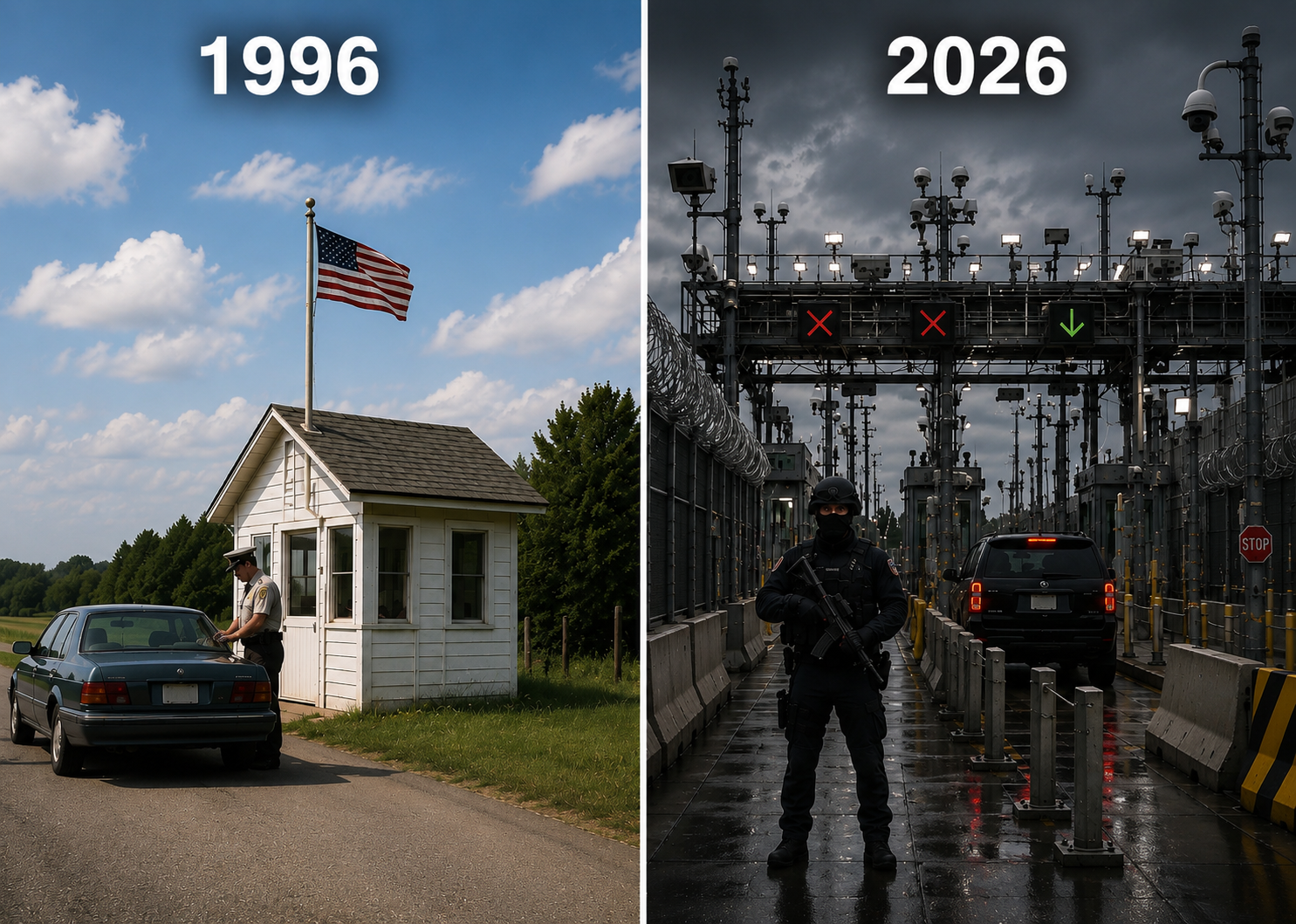
In 1996, the border could still be imagined, in places, as a small house, a uniformed guard, a car window rolled down, a human exchange. That image never captured the full power of a national boundary. But there was still room, at least in some places, for managed trust.
In 2026, the familiar North American border has taken on a harder look: inspection lanes, surveillance masts, warning signs, concrete barriers, steel gates, armed officers, and a presumption that the person approaching must first be sorted as a risk.
The Haskell Free Library was built against that presumption. It did not deny the border. It made the border less absolute. It offered a modest civic argument: two countries could share a room without surrendering sovereignty; a line could be real without becoming total; entering a library did not have to be treated as a breach.
That argument has not vanished.
It has been narrowed to a doorway.
On June 10, the new Canadian entrance will open officially. The door will work. The library will endure. People will still read there.
But a building created to make a border less absolute now has to prove it with doors, rules, and money.
Bibliography
1. WCAX, “Haskell Free Library opens second entrance after federal pressure,” May 15, 2026.
2. Haskell Free Library and Opera House, institutional mission and history.
3. Haskell Free Library and Opera House, Canadian Door / visitor access rules.
4. Associated Press and DHS/CBP reporting on the access restriction and smuggling rationale.