The Haskell gave border communities one of the few public rooms where the line could be present without governing every human encounter. A grandmother from one side and a grandson from the other could understand the absurdity of the border without having to defeat it. A reader could walk into a building rather than an incident.
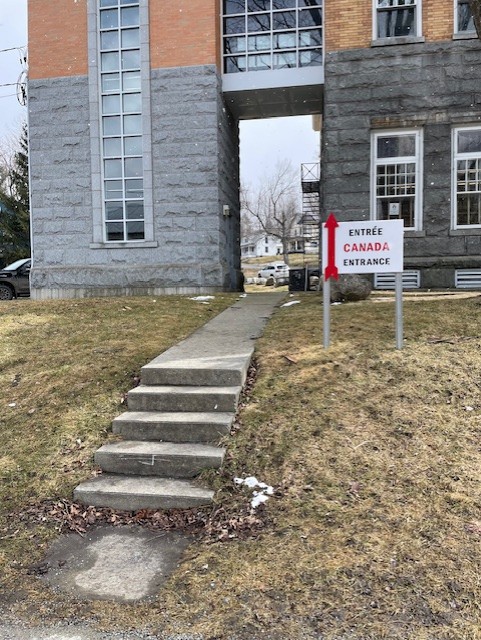
Now the old habit has been converted into instructions: come from your side, use your door, leave the way you came.
The official reason is security. U.S. Customs and Border Protection says the area had seen increased illicit cross-border activity. DHS said smugglers and drug traffickers were exploiting Canadian access to the U.S. entrance. There was a known firearms-smuggling case connected to the library. That matters. Borders are operational facts to the agencies responsible for enforcing them.⁴
But enforcement has now become the main language used to understand a library.
The answer has been expensive and revealing. The Canadian Door project carries an estimated cost of $650,000. The library says $320,000 had been secured through GoFundMe, PayPal, individual donations, and foundations, with additional fundraising and government funding applications underway.⁵
That money did not build a new public institution. It bought a workaround to preserve access to one that already existed.
The Haskell is a small place. That is why it matters.
Large ruptures usually arrive first as changes in ordinary rituals. A border hardens, and the evidence appears as a sidewalk closed, a door reassigned, a family visit prohibited, a patron told to leave through the same national entrance by which she arrived.
The larger pattern is already measurable. Statistics Canada reported that Canadian return trips from the United States in April 2026 were still 30 percent below April 2024 levels. Automobile trips were down 31.4 percent. Air trips were down 26.4 percent.⁶
Public opinion has moved in the same direction. Pew found in 2025 that only 34 percent of Canadians held a favorable view of the United States, down 20 points from the year before and at or near historic lows.⁷ Taken together, the numbers describe more than inconvenience. They show a relationship in which ordinary crossings have become more politically and emotionally costly.
More Canadians are deciding not to cross.
Canada and the United States remain allies. They trade, cooperate, share intelligence, and remain tied together by families, roads, businesses, schools, and memory. The old Eastern Europe comparison belongs only at the level of architecture and feeling: booths set back from the road, cameras over inspection lanes, concrete islands, floodlights, bollards, armed officers, a driver waiting for permission to proceed.
That is why the European comparison matters. Europe has retained borders and sometimes restores internal checks. But the Schengen idea remains a profound political choice: trusted neighbors should not live as permanent suspects when they cross an internal line.