That is the strongest argument for patience. The White House is not a museum sealed behind glass. It is a working seat of government. It has to host leaders, mourn the dead, celebrate victories, greet schoolchildren, welcome athletes, and stage the rituals of a democracy.
The problem is not change. The problem is possession.
Trump’s changes do not feel like stewardship. They feel like tenancy without restraint: the public house converted, corner by corner, into an extension of one man’s taste.
Start with the Rose Garden. Trump said the grass was wet and inconvenient, especially for women in high heels. “Their heels are going through the grass, like, four inches deep,” he told The Spectator, according to public-radio reporting.⁴ The Associated Press reported the same practical justification: the grass was always wet, and high heels were a problem.⁵
So the garden became a patio.
The National Park Service now describes the renovation in one flat sentence: the Rose Garden “was turned into a patio with roses lining the perimeter.”⁶
There may be no better sentence for the whole project. The garden became a patio because the tenant wanted a patio.
Then came the wing.
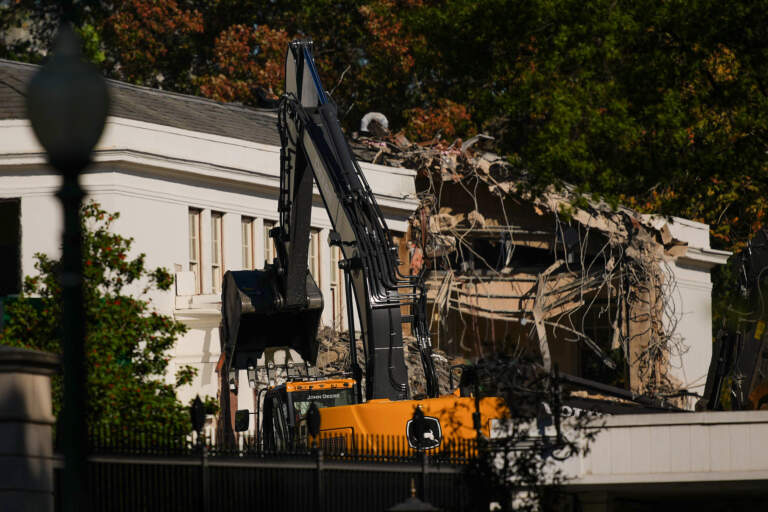
The East Wing is where taste became structural. The White House announced that the new ballroom would be built where the East Wing stood, describing the project as a major expansion of official entertaining space. Reuters later reported that the $400 million project was challenged by the National Trust for Historic Preservation, which argued that Trump could not proceed without congressional approval. A federal judge temporarily halted the project; an appeals court later allowed construction to continue while the fight proceeded.⁷
The legal issue matters because it states plainly what the architecture implies. Reuters reported that Judge Richard Leon emphasized the president’s role as a steward of the White House, not its owner.⁸
That is the line Trump keeps crossing.
A president may choose paintings. He may change carpets. He may argue with historians over a color. But when a wing of the White House complex comes down for a ballroom, the question is no longer decorative. It is civic.
The White House presents the ballroom as modernization: a secure space for state functions and large events. That argument is not frivolous. Outdoor tents are not ideal for high-level government events. Security matters. The house must function.
But modernization is not the same as conversion. The language around the ballroom keeps sliding from official need into Trump’s old vocabulary: size, luxury, donors, construction, grandeur. The familiar grammar of real estate returns to the public house.