The hallway got the same treatment, only smaller. ABC News reported that Trump installed plaques beneath presidential portraits in the Rose Garden colonnade and used some of them to insult or make unfounded claims about predecessors, including Joe Biden and Barack Obama. PBS, through PolitiFact, described the plaques as echoing the style of Trump’s own social-media posts.⁹
He did not simply hang portraits. He captioned the presidency in his own voice.
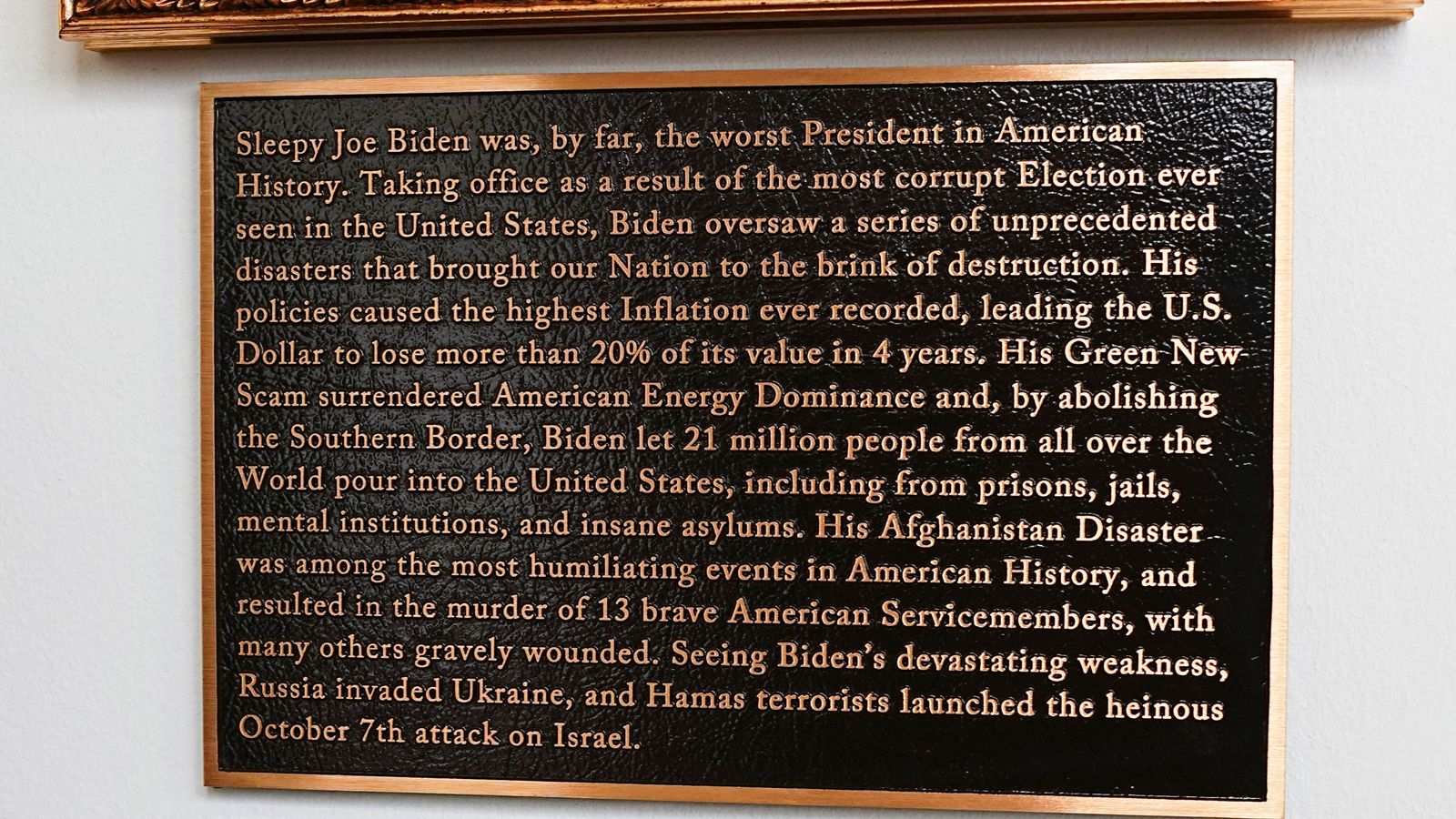
That detail is minor beside a demolished wing, but it may be more revealing. Trump does not merely want to occupy the setting. He wants to narrate it. He wants the walls to speak in his idiom.
The Oval Office has followed the same pattern. NPR described Trump’s second-term office as newly crowded with portraits, statues, gold touches, trophies, and Trump-branded coasters.¹⁰ Some of it can be removed. Some of it may have been privately paid for. Some of it is only taste.
But taste is not neutral when it is imposed on public space.
The Oval Office is not a hotel lobby. The Rose Garden is not a patio at a club. The South Lawn is not an event rental. The East Wing is not a buildable lot waiting for a developer. These are parts of an inherited national setting. They do not belong to the man who occupies them for a term.
Each act can be defended separately. The cage is temporary. The garden is more usable. The ballroom is larger. The plaques are just captions. The gold can be removed. The donors will pay. The president is entitled to leave his mark.
Together, they say something harder to dismiss: the house is being treated less as a trust than as a property under management.
That is why the cage matters. The ballroom may be more consequential. The East Wing may be more legally serious. The Rose Garden may be more historically sad. But the cage is the crude symbol that explains the rest. It says, physically, that the White House is available.
A public house can host ceremony. It can host mourning, music, diplomacy, dinners, arrivals, departures, Easter egg rolls, veterans, athletes, and the rituals of state. But there is ceremony, and there is spectacle. There is public ritual, and there is private appetite wearing public colors.
The cage belongs to the second category.
It will come down. That is not the comfort it appears to be. The damage is what it teaches: that the lawn was available, that the house could be used, and that a public trust could be bent toward private spectacle.
Bibliography
1. Associated Press, “UFC Fighting Cage Rises on White House Lawn for Bout Celebrating America’s 250th Anniversary,” May 27, 2026.
2. Reuters, “Construction of Cage-Fighting Arena Transforms White House Grounds,” May 27, 2026.
3. Axios, “The History Behind Trump’s Newly Paved Rose Garden,” August 4, 2025.
4. GPB / NPR, “Trump Makes Over the Rose Garden, Mar-a-Lago Style,” August 23, 2025.
5. Associated Press, “Trump’s Paved Makeover of White House Rose Garden,” July 25, 2025.