With no words to express grievances, how can one even begin to question or confront oppression?
Similarly, Huxley’s Brave New World paints a picture of a society pacified by endless distractions, where discomfort and complexity are banished in favor of an easy, controlled existence. In Trump’s approach, the removal of terms like “trauma,” “oppression,” and “race” creates a sterile narrative. Without the language to describe hardship, the messy reality of life is glossed over, leaving citizens with a sanitized view of their own experiences. As civil rights attorney Sherrilyn Ifill put it, “Language shapes reality. If you can’t name your pain, you can’t heal from it.” The very act of erasing these words becomes an attempt to gaslight the public into believing that the challenges they face are less severe—or perhaps not there at all.
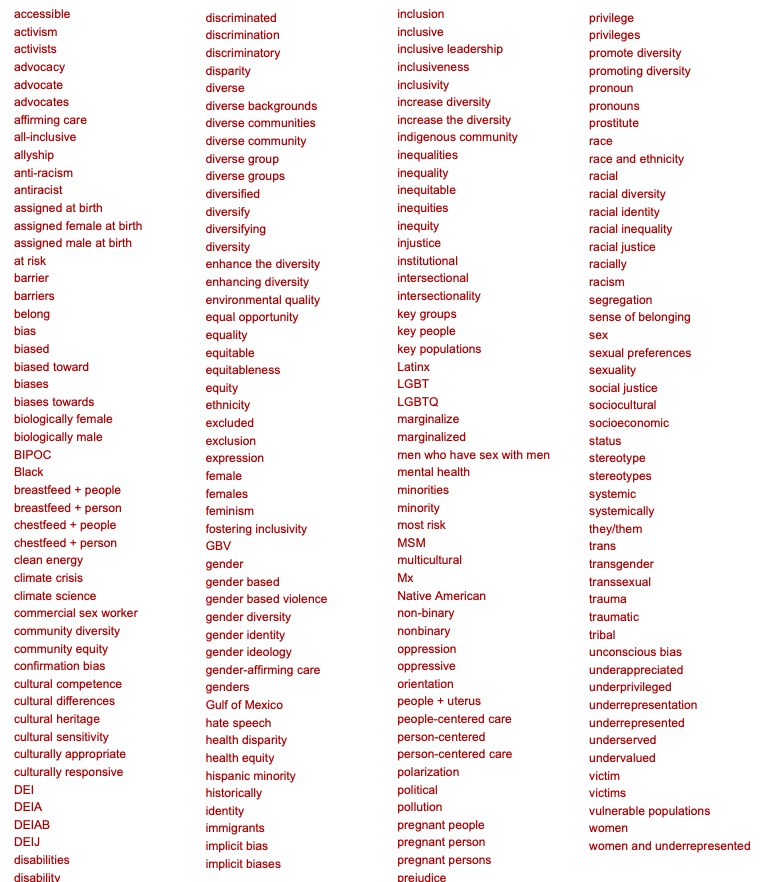
But the story doesn’t end with abstract theory. The consequences of this linguistic purge are startlingly concrete. The word lists compiled by federal agencies were not limited to social or cultural terms; they spanned an array of topics. Among them were descriptors like “non-binary,” “climate science,” “cultural competence,” and “racial inequality.” Even more surprising was the inclusion of terms as mundane as “Gulf of Mexico”—a geographical feature that, at first glance, seems far removed from the battle over identity and policy. This breadth of censorship reveals that the initiative was not a finely tuned instrument for targeting controversial ideas; it was more akin to a cultural lobotomy, erasing details that give our national story its depth and texture.
The irony of this approach becomes palpable when one considers how the administration publicly champions free speech. On his first day back in office, President Trump signed an executive order decrying what he called the “Biden administration’s censorship of speech,” particularly on social media. Yet behind the scenes, the very same commitment to free expression evaporated when it came to internal communications and official documents. As one anonymous State Department official bluntly put it, “It’s not about free speech. It’s about approved speech.” In this framework, freedom becomes a selective privilege—a shield for expressing certain ideas while denying the language needed to articulate others.
There is an unsettling suspense in knowing that every time a word is removed, a part of our shared reality disappears. In Trump’s version of governance, the language of dissent, of challenge, and of protest is being quietly excised. Specific words that carry immense weight—words that appear both in his rhetoric and in the oppressive lexicon of Newspeak—are being redefined. For example, terms like “freedom,” “truth,” and “justice” now serve dual roles. In one context, they are the rallying cries of democracy; in another, they become tools of manipulation designed to blur the lines between genuine expression and controlled dialogue.