This covert campaign against language doesn’t just affect policymakers or government employees—it touches every corner of society. For students grappling with textbooks stripped of critical vocabulary, for teachers trying to convey complex social realities, and for parents and community members who rely on accurate historical narratives, the implications are profound. A 17-year-old student from Texas once confided, “They say we’re being protected from ideas, but it just feels like we’re being kept in the dark.” Such voices, filled with a mix of confusion and defiance, remind us that language is not simply a tool for communication—it is the medium through which we understand ourselves and our world.
The suspense builds as one considers the potential long-term effects of these changes. With each word that vanishes, the capacity for dissent and dialogue diminishes. When history is rewritten through the lens of sanitized language, the vibrant debates and controversies that drive progress are replaced by a homogenized narrative. In the end, the government’s assault on language might leave us with a society where the truth becomes elusive, and the very idea of questioning authority is quietly extinguished.
Yet, amid this encroaching darkness, there is a call to action. The antidote to this censorship is not passive resignation but active resistance. Whenever we speak of diversity, inclusion, or justice—even when those words are branded as “problematic”—we assert our right to a full, unfiltered reality. We must ask ourselves why certain words are being removed and who benefits from their absence. By continuing to use and teach these words, we refuse to allow language to become a weapon of control.
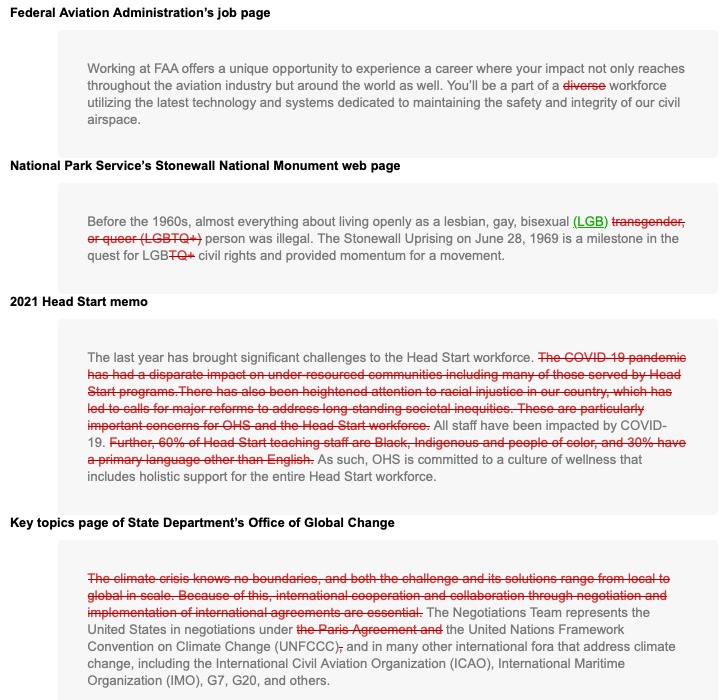
As Orwell ominously predicted, “The Revolution will be complete when the language is perfect.” We must ensure that perfection does not come at the cost of truth and human complexity. The fight to preserve our language is, in essence, a fight to preserve the very soul of our democracy. In this unfolding drama, every word spoken is an act of defiance against a system that would erase the past, silence dissent, and ultimately, control the future.
Sources
1. New York Times, "These Words Are Disappearing in the New Trump Administration" (March 7, 2025) George Orwell, 1984 Aldous Huxley, Brave New World Sherrilyn Ifill, Civil Rights Attorney and Scholar
Appendix:
The following is excerpted from the New York Times, March 7, 2025. This is a list of words flagged for exclusion in government documents: